WRITING
STUDIOVOICE #6 — Ken Suzuki’s The Smooth Society and Its Enemies
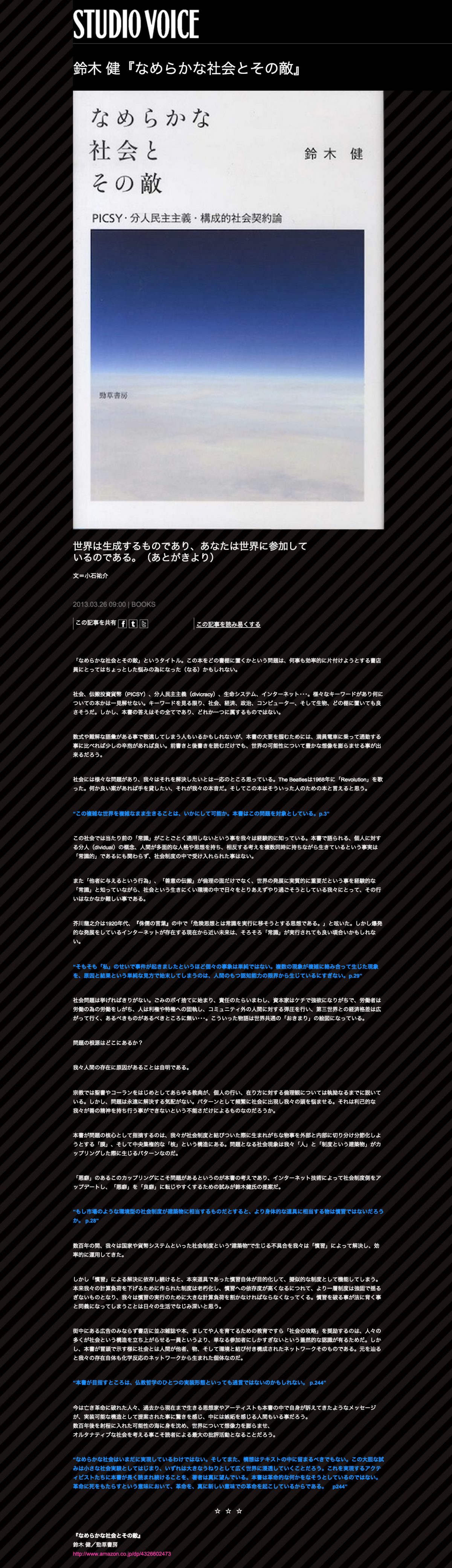
Ken Suzuki, The Smooth Society and Its Enemies
The Smooth Society and Its Enemies by Ken Suzuki
The world is something generated, and you are participating in the world.
A book titled The Smooth Society and Its Enemies. For a bookseller trying to keep shelves efficiently organized, deciding where to place it may be a minor nuisance. Society, PICSY, dividuality, life systems, the internet: its keywords could be placed in sociology, economics, politics, computers, or biology. The answer is all of them, and none of them.
Those intimidated by numbers or difficult terms might do well to read this book on a train commute, carrying with them at least a junior-high-school level of mathematics. Even the preface and afterword are enough to open a generous space for imagining the possibilities of the world.
Society has problems, and at least on the surface we wish to solve them. The Beatles sang “Revolution” in 1968. If there is a troublesome disease, one wants to lend a hand. That is one of the book’s essential attitudes, and it may be called a book for people who still believe that a hand can be lent.
The book argues that keeping this complex world complex is possible. In the society we inhabit, the commonsense we assume as obvious often no longer works. We know from experience that acts such as giving to others or passing on good things are important not only ethically but practically, and yet in the difficult environment called society, these acts are not easy to sustain.
Ryunosuke Akutagawa once wrote that an idea is dangerous when it tries to move common sense into practice. In the present, with the internet developing explosively, the future may be nearing a point at which common sense should finally be implemented. The book asks how that might be done without turning the dream into another administrative nightmare.
The core of the problem, as the book points out, is a structure in which we divide things into an external membrane and a centralized nucleus whenever they are tied to social institutions. Social phenomena are born when human beings are coupled with the architectural object called an institution. Suzuki’s proposal is to update such institutions through internet technology, transforming malignancy into something closer to goodness.
For centuries, we have solved the failures of social architectures such as states and currency systems through habit. But when we depend too much on habit, the tool becomes the purpose, and an institution created to reduce computational burden ages into a quasi-natural system that is harder to shake than the problem it was meant to solve. Breaking habit can become as difficult as breaking law.
Advertisements in the street, magazines on shelves, even education that rewards the “strategy” of society, all suggest that people tend to see themselves less as builders of social structures than as mere participants. Yet society is a network constructed through human beings, others, objects, and environments. Our existence is also a local node born from that network.
What the book aims for may be a practical form of Buddhist philosophy. The messages revolutionaries, thinkers, and artists have repeated through time appear throughout the book, but what is new is that it tries to present them as specific possibilities in our daily world. To imagine an alternative society may become one of the reader’s greatest acts of criticism.
The Smooth Society and Its Enemies
Ken Suzuki, Keiso Shobo.