米ファッション研究の第一人者が語る、「ファッションはアートか?」よりも問うべきこと。ヴァレリー・スティール(FITミュージアム館長)インタビュー
クラインシュタイン代表の小石祐介氏が、ファッション研究の第一人者として知られ、数多くの象徴的なファッション展覧会をキュレーションしてきたニューヨークのFIT美術館(ファッション工科大学美術館)の館長兼主任キュレーターであるヴァレリー・スティール氏(Velerie Steele)にインタビューを行いました。Tokyo Art Beatのために収録されたインタビューは英語で行われましたが翻訳され、日本語で公開されています。以下は再掲載の許可を得たインタビューのオリジナルの英語版です。ぜひ御覧ください。
KLEINSTEIN representative Yusuke Koishi interviewed Valerie Steele, director and chief curator of the FIT Museum (Fashion Institute of Technology Museum) in New York, who is renowned as a leading authority in fashion studies and has curated numerous impressive fashion exhibitions. Their dialogue covered a wide range of topics, from the relationship between fashion and art to the current state of fashion research and the future of Japanese fashion. This interview was published in Tokyo Art Beat. The interview was conducted to commemorate the June publication of “Fashion Theory: Selected Works of Valerie Steele” (Adachi Press), a book compiling Steele’s theoretical writings.
“The following dialogue is a translated interview text with permission to reprint from Tokyo Art Beat. The translation is by Kleinstein.”
Fashion Theory in Practice: Valerie Steele in Conversation with Yusuke Koishi
Known as a leading figure in fashion studies and having curated numerous impressive fashion exhibitions, Valerie Steele serves as Director and Chief Curator of The Museum at the Fashion Institute of Technology (FIT Museum) in New York. She has consistently illuminated the intersections of fashion with culture, society, and gender. A collection of her essays, Fashion Theory: Selected Essays by Valerie Steele (Adachi Press), was published in June. To commemorate the publication, Steele visited Japan, where Yusuke Koishi (KLEINSTEIN) conducted this interview. Their dialogue explores the relationship between fashion and art, the current state of fashion research, and Japan’s future prospects.
Contents
- A researcher who has walked between fashion and the field of knowledge visits Japan
- “Is fashion art?” The conclusion is still out
- Criticism directed at MET’s Saint Laurent exhibition
- Fashion studies today
- Fashion as phenomenon
- How she sees Japan now
A researcher who has walked between fashion and the field of knowledge visits Japan
In recent years, fashion exhibitions have become popular topics at museums worldwide. On June 7th, a lecture by Valerie Steele, a leading figure in fashion exhibition curation, was held in Tokyo. Since 1997, she has served as Chief Curator of The Museum at FIT, and since 2003 as Director, having organized over 25 fashion exhibitions.
“Japan and America are similar in one respect—both have imported European culture while creating their own unique popular cultures,” she said at the beginning of her lecture.
As many in the fashion industry and beyond recognize, the undisputed “capital” of fashion is Paris, France. Meanwhile, New York, despite reigning as the economic and cultural center of Western society, is not regarded as the fashion capital. From the perspective of Paris, the fashion capital, both America and Japan—existing in separate realms of West and East—are merely outsiders.
America is the capital of capitalism, and its economic activities have generated new social movements. New music, films, and art have intertwined with fashion, and people’s consumption has driven society forward.
Indeed, many developments in contemporary fashion have originated in America. Louis Vuitton’s shows attract celebrities and VIP customers from around the world, but this brand began creating clothing beyond bags and trunks only after American designer Marc Jacobs was appointed as Creative Director. The very birth of Fashion Week itself was largely influenced by America.
Valerie Steele says her career was determined when she saw the exhibition “Three Women: Kawakubo, Vionnet, McCardell”The exhibition featured three designers: Madeleine Vionnet, a French designer considered one of the pioneers of modern clothing design; Claire McCardell, an American designer who would be reevaluated for changing ready-to-wear design for the masses; and Rei Kawakubo. at FIT Museum in 1987. This exhibition, organized by her predecessors, Japanese-American Harold Koda and Richard Martin, was created around the provocative question: What makes women designers’ designs different from those of male designers?
Steele’s own exhibitions have often contained critical content, particularly displays that invite reconsideration of values taken for granted in Western society. “China Chic: East Meets West” looked to China while Japanese fashion was receiving attention, presenting the existence of non-Western fashion history as a counterpoint to the assumption that fashion history equals Western history. The “PINK: The History of a Punk, Pretty, Powerful Color” exhibition reconsidered the meaning and semiotics of color, examining how stereotypical associations like pink being feminine and blue being masculine came to be.
Her exhibition catalogues contain academic essays examining fashion from multifaceted perspectives including art theory, sociology, and costume history, attracting attention not only from researchers but also from fashion industry insiders. The lecture focused on the essays collected in “Fashion Theory: Selected Essays by Valerie Steele” (Adachi Press), published to coincide with her visit to Japan, and explanations of exhibitions she has organized. After the lecture, I conducted this interview with her.
“Is fashion art?” The conclusion is still out
Koishi: At the beginning of your lecture, you mentioned that “Japan and America have absorbed European fashion while creating their own unique expressions.” As an American researcher, what do you consciously consider in fashion research? Actually, I was surprised by how little mention there was of Japanese and American designers in “The His Story of International Fashion” by Didier GrumbachHistoires de la mode (2008) by Didier Grumbach, the former president of the Chambre Syndicale. I found myself thinking, “Wait, wasn’t Japan first with this? Isn’t this American influence?”
Steele: France tends to view fashion only through French lenses. It’s somewhat imperialistic. I’ve even had French curators tell me, “America has no fashion except for jeans!” (laughs)
Koishi: I learned from your lecture that it was ironically Robert Riley, FIT’s first director, who historically reevaluated Paul Poiret, the French couturier who had nearly disappeared from history. The episode about Pierre Bergé being angry when you organized an exhibition comparing Halston and Yves Saint Laurent was also fascinating.“Yves Saint Laurent + Halston: Fashioning the 70s” (2015) curated by Valerie Steele. https://exhibitions.fitnyc.edu/exhibitions-timeline/yves-saint-laurent-halston-fashioning-the-70s/ Since this is an interview for an art media outlet, I’d like to ask about the relationship between fashion and art, as well as about Japan, though these may be somewhat predictable questions. Do you personally collect art?
Steele: Yes, modestly, though. I occasionally buy works by artists living in New York. I go to galleries almost every week, but I don’t have the budget to buy something every time (laughs).
Koishi: What do you think is the difference between the experience of buying art and buying fashion?
Steele: These days, art always involves discussions of resale value. What I remember about fashion shopping is a jacket with Frankenstein stitching from Comme des Garçons’ Spring/Summer 2005 “Punk Ballerina” collection.
Koishi: The one that looked like a baseball glove, right? That collection had powerful visuals, but it was also interesting because you couldn’t immediately understand how it was made.
Steele: Yes. My heart was pounding when I bought that. My husband saw me and said, “Maybe you should get a Comme des Garçons credit card too?” and I suddenly replied, “It’s okay! This is art!” “Fashion is art” is quite convenient in situations like that (laughs).
Koishi: The debate about whether fashion is art has been going on for decades now.
Steele: Yes. I sometimes get attacked when this topic comes up. I had a big conference quite a few years ago on fashion and art, and I pointed out that the issue still isn’t decided. What I often say is that the conclusion to the question “Is fashion art?” is still out. What’s crucial is whether fashion designers themselves think their work is art, and whether other artists—painters and sculptors—consider fashion to be art. There was a time when classical music was considered art, but jazz wasn’t. But now jazz is fully recognized as a legitimate art form. Photography too. Once, painting was art and photography wasn’t, but now photography is completely accepted as a form of art.
I think fashion is in a process of “artification.” But it’s just a “process,” and fashion as a whole probably won’t become art. Besides, much of the rationale for calling fashion art is somewhat outdated. People say “it’s art because it’s beautiful,” but contemporary art isn’t necessarily beautiful, right? They say “it’s art because it involves advanced craftsmanship,” but contemporary art can be crudely made and still constitute artwork. The very definition of art itself is in flux.
So ultimately, I think what matters most is whether the person and those around them think “this is art.” On the other hand, just because Pierre Bergé said “Yves Saint Laurent is an artist” doesn’t sufficiently convince everyone. Some people consider him “a talented designer.” What I’m more interested in regarding fashion is “whether it’s good fashion.” Personally, I find that a more interesting question than whether fashion is art.
Koishi: Fashion is often criticized for being more commercial compared to art. What do you think about this point? I sometimes think that buying and wearing Maison Margiela in the ’90s was similar, as a consumer activity, to hanging an original Warhol print in your home in the ’80s.This perspective is discussed by interviewer Yusuke Koishi in “Art and Fashion: Their Respective Games”on Tokyo Art Beat – https://www.tokyoartbeat.com/articles/-/art_and_fashion
Steele: Fashion is commercial, but so is the art world. However, generally speaking, I think people want art to have some sublime purpose. And fashion doesn’t fully appear that way. In fact, there are scenes in fashion where merchandise is just circulating.
Criticism directed at MET’s Saint Laurent exhibition in 1983
Koishi: Speaking of commercialism, a major controversy arose from the Yves Saint Laurent exhibition held at the Metropolitan Museum of Art (MET) in New York in 1983. This exhibition, led by Diana Vreeland, former editor-in-chief of Vogue, was severely criticized by the art world as being a commercial display. Andrew Bolton of MET’s Costume Institute mentioned that this criticism made it difficult to organize solo exhibitions of living designers at museums afterward.
Steele: The 1983 exhibition received terrible reviews. Many people in the industry were terrified by this reaction. Dealing with living designers in museums was seen as too commercial. The fact that Saint Laurent himself was heavily involved in the exhibition structure, making it appear as if he had bought the exhibition, was also criticized. Something similar happened with the Armani exhibition at the Guggenheim, which also received harsh reviews. I remember newspapers condemning it, asking “Motorcycles, now Armani? Did he buy the exhibition?”
Koishi: When I saw the Yves Saint Laurent retrospective at the National Art Center in Tokyo in 2023, I was honestly quite disappointed. From the perspective of contemporary fashion values and design methodologies, it felt somewhat dated. Just displaying torsos and photographs while claiming “this is artistic, this is amazing” wouldn’t necessarily resonate with first-time viewers. It would have been better if the context of Saint Laurent’s era were more apparent, but that power didn’t come through.
Steele: Fashion exhibitions need to leave visually striking impressions for contemporary audiences. In that sense, the Alexander McQueen retrospective “Savage Beauty”(2011) was a good example. Not just designer solo shows, but thematic exhibitions are similar. For my curated “Gothic: Dark Glamour”(2008) exhibition, we needed staging and music that would evoke the image and its background. So I collaborated with Simon Costin to create sets suggesting coffins, ruined castles, graveyards, laboratories, and clubs.
Koishi: Over 30 years after the Saint Laurent exhibition, MET held “Rei Kawakubo / Comme des Garçons: Art of the In-Between” in 2017. This was the museum’s second solo exhibition of a living designer. How was this received?
Steele: Rei Kawakubo’s exhibition was different from the Saint Laurent show. First, she was viewed as a conceptual designer, which was a major difference. What I found personally interesting was that journalists didn’t mind that she was deeply involved in the exhibition design. Rather, it was seen as part of the creation she does, like spatial design or store creation. As a result, her work was considered essentially a kind of art, and that work was deemed worthy of museum display.
However, from an artistic perspective, for Saint Laurent, being “inspired by art” meant creating something like a jacket with flower embroidery. I think he did such work as sincere expression, not irony or joke. It’s different from contemporary irony like Jeff Koons putting the Mona Lisa on a Louis Vuitton bag.
Koishi: I see. On the way home from the Saint Laurent exhibition at the National Art Center, my wife and I debated why the 1983 exhibition received such criticism. Looking back at the New York art scene of that time, conceptual artists like Andy Warhol, who had connections with Saint Laurent, as well as Donald Judd and Dan Flavin, were already quite active. And on top of that, a lot of artists from Europe were coming to New York and making a big impression—Joseph Beuys, for example. I wondered what audiences familiar with that art scene thought when they saw the 1983 exhibition. I don’t think New Yorkers interested in contemporary art were rejecting French classical artistic views, but maybe they expected something more intense and non-trivial when the fashion superstar arrived.
Steele: You’re right. Actually, interest in conceptual fashion already existed in the early ’80s. Do you remember? In 1982, Artforum‘s cover featured Issey Miyake’s work using a rattan bodice and polyester workThis cover is still available in Artforum’s archives. https://www.artforum.com/features/editorial-2-208410/ I think that was the first time a fashion piece graced the cover of an art magazine. By 1982, there was already growing awareness that Japanese avant-garde designers were beginning to create something different from mere commercial fashion, something closer to art.
Fashion studies today
Koishi: Tell me about when you decided to pursue fashion research at Yale University. In your 1992 essay “F-Word” (included in Fashion Theory), you wrote about episodes from that time. When you told people around you that you wanted to research fashion, you received quite cold stares. Does that atmosphere still exist? In Japan, too, fashion work and fashion itself tend to be somewhat looked down upon.
Steele: Not as much as before, but it’s still deeply rooted. At the time, fashion was shunned as an academic subject. Now it’s increasingly recognized as “potentially interesting research material,” but most universities still don’t have “fashion departments.” They could at least create a “fashion history” track within art history departments, but even that isn’t easy.
Before my predecessor at FIT, Richard Martin, passed away, I was asked to take over the class he had been teaching at Columbia University. It was such a popular class that undergraduates, graduate students, and even Fulbright scholars all wanted to take it. But the art history faculty never said, “Let’s create a fashion history position.” Even now, institutional problems are significant. When someone wants to research fashion in a doctoral program, they first need to find an advisor, which isn’t easy in itself. Even in France, very few people have PhDs in fashion studies, so I’m often asked to serve on dissertation committees.
Koishi: Have you ever considered the option of working within the fashion industry?
Steele: No. However, the environment has changed considerably from before. Particularly, there are increasing cases of people with master’s or doctoral degrees in fashion joining luxury brands, handling archive management, or writing brand histories. Some might call that propaganda work. But I think it’s wonderful that people with very academic backgrounds are involved in cool collections.
Fashion as a phenomenon
Koishi: When evaluating fashion designers, what criteria do you use?
Steele: Influence on the future. How that designer subsequently influenced others, became part of society, and created phenomena. If that happens, the designer becomes deeply rooted in history.
Koishi: I see. In the essays collected in “Fashion Theory”, you mention that “fashion is a social phenomenon.” For example, do you think someone who creates social phenomena themselves can be called a “fashion designer”? Using Vivienne Westwood as an example—she’s the designer, but could Malcolm McLaren, who was influential behind the scenes, be called a designer in a broader sense?
Steele: I’ve never considered Malcolm a designer. Malcolm was certainly full of ideas, an art school graduate and very influential figure. But I don’t think he deserves credit for Vivienne’s entire body of work. When Richard Martin was interviewing McLaren at FIT, I shouted from the balcony, “What about Vivienne Westwood!?”
Koishi: I asked this question because fashion’s macro movements are now influenced by a non-designer player, such as major capital. Considering the influence of business leaders like Bernard Arnault of LVMH and Tadashi Yanai of Uniqlo, should such figures be recognized as “fashion (phenomenon) designers” in the broad context of “designing” fashion phenomena?
Steele: I don’t think so. I wouldn’t stretch the interpretation that far. Fashion industry executives and manufacturers are certainly deeply involved in fashion processes, but they’re more like “dealers” than creators. They’re involved not only in the fashion world but also in the art world. But they’re not playing creative roles in creative ideas; they’re acting as capital bearers—that’s my view.
Koishi: Are there any current fashion phenomena that concern you?
Steele: The gigantification of luxury conglomerates and fast fashion conglomerates. Independent people are caught in between, and the middle ground seems to be narrowing. I’m also concerned about issues like overproduction and labor exploitation.
Koishi: Speaking of luxury companies, Pharrell Williams is now serving as Creative Director of Louis Vuitton. From your perspective as a historian, how do you interpret this change?
Steele: Pharrell is not just a musician but a celebrity in contemporary society. I think it’s a manifestation of how gigantic fashion companies need such talent more than ever.
How she sees Japan now
Koishi: Finally, I’d like to discuss Japan. What’s your favorite area in Tokyo?
Steele: This might sound predictable and cliché, but I love Omotesando. Walking up and down the hills makes me feel like I’m home. Tokyo’s charm is that I can discover new places and shops every time I visit. I once toured small boutiques with Tiffany Godoy (current editor-in-chief of Vogue Japan), and one shop that caught my attention was called “Dog.”
Earlier, you mentioned that in the early 1980s, triggered by Japanese designers’ activities, there was a sense that conceptual fashion, different from commercial fashion, was emerging. All those designers had flagship stores in Omotesando, followed by luxury brands. Your “Japan Fashion Now” (2010) exhibition at FIT also featured the transformation of Omotesando and Harajuku, and in the essay you wrote then, “Is Japan Still the Future?” (included in Fashion Theory), you reconsidered Japan’s global rise in the 1980s.
Since 2020, interest in Japan seems to have increased further. Foreign visitors to Japan have increased fivefold. “Japanese things, or rather, calling Japanness,” are receiving mainstream attention like never before. Do you sense changes from America’s perspective? European buyers are studying Japanese boutiques, and recently we see creators moving to Tokyo or opening stores there.
Steele: That’s an interesting movement. Japanese visuals are always attractive and strong, so it’s not surprising. However, compared to the shock of the 1980s, it feels different now. In the 1980s, Japan was unstoppable. For Westerners, it felt like Japan might conquer the world. There were widespread anxieties that if Japan continued its economic growth, both America and Europe would decline. The symbolic phenomenon was “Westerners starting to eat raw fish,” which was unthinkable at the time.
Koishi: That was during the bubble era. Looking at Ridley Scott’s “Blade Runner” (1982), you can see how conscious of Japan it was. Donald Trump frequently mentioned Japan then, and it’s surprising that Warhol appeared in Japanese TV commercials. What do you think are the reasons Japan is receiving attention now?
Steele: Japan’s current attention isn’t just due to the often-cited weak yen. I think it’s the “rise of Far East Asia.” China, South Korea, and East Asia as a whole are rising now. While the political and economic center has shifted to China, Japan is the most culturally sophisticated in East Asia. Above all, Japan is the “most familiar Far East” for Westerners.
So just as Paris was for Western society, Tokyo has the potential to become Asia’s fashion capital. There could be a future where young designers from China, South Korea, Indonesia, and Thailand present collections in Tokyo. The consciousness that “if East Asia becomes increasingly important, Japan will become even more important” will continue to strengthen within global trends. What’s challenging for Japan in this context is the problem of declining birthrate and aging population. A society with only people over 80 can’t maintain creativity. You need young generations.
Valerie Steele Director and Chief Curator of The Museum at the Fashion Institute of Technology (FIT Museum) in New York. After obtaining her Ph.D. in Modern and Contemporary European Cultural History from Yale University Graduate School, she published Fashion and Eroticism: Ideals of Feminine Beauty from the Victorian Era to the Jazz Age (1985), gaining attention for her historical research on sexuality in fashion. Since 1997, she has served as Chief Curator of FIT Museum, and since 2003 as Director, organizing over 25 fashion exhibitions and writing and editing numerous catalogs and books. Her research, which views fashion as part of culture, has earned high praise through aesthetic and empirical insights combined with rich knowledge of history, literature, and art. In 1997, she founded Fashion Theory: The Journal of Dress, Body and Culture, establishing the foundation of fashion studies, and edited the Encyclopedia of Clothing and Fashion (2005).


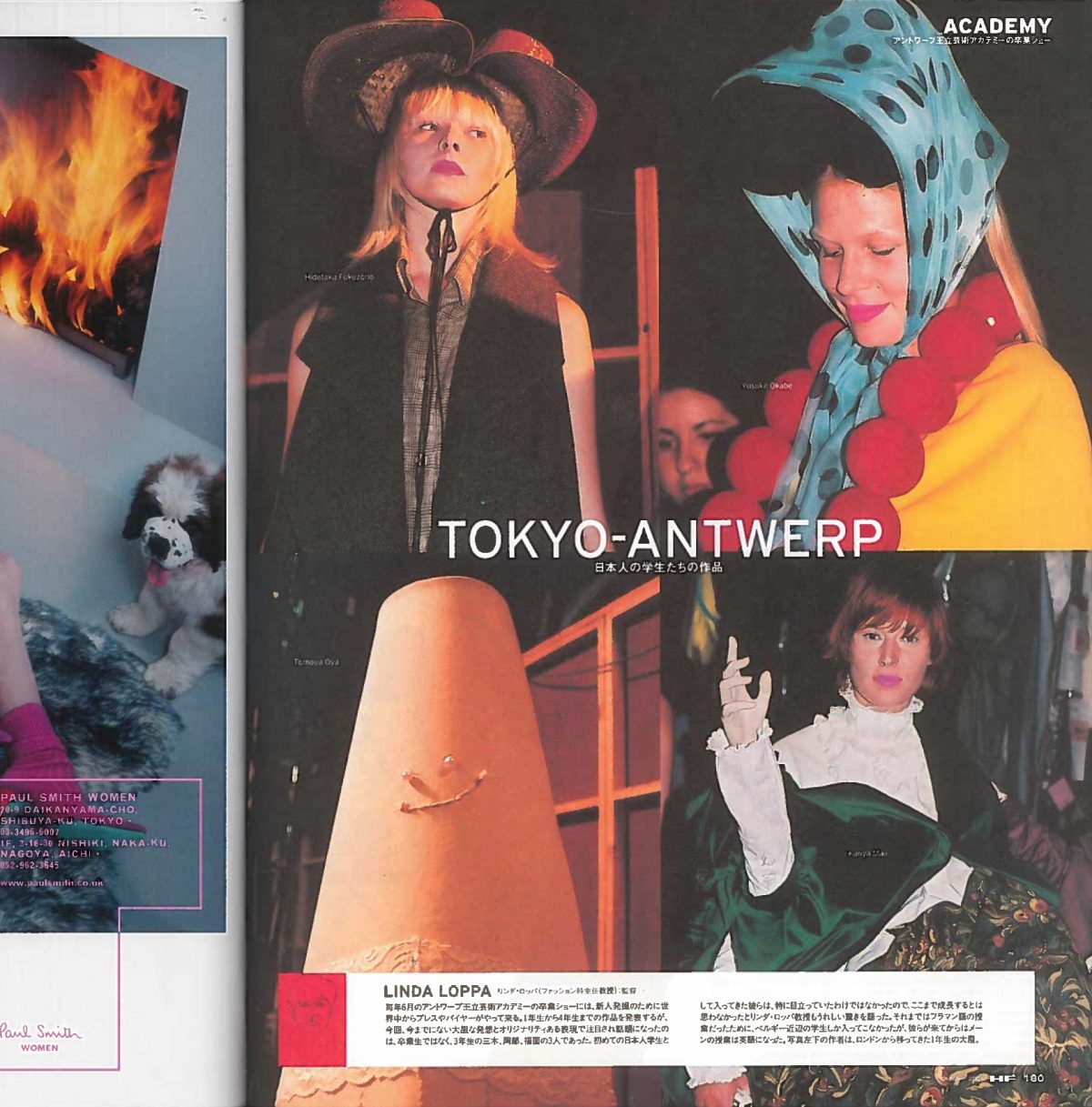
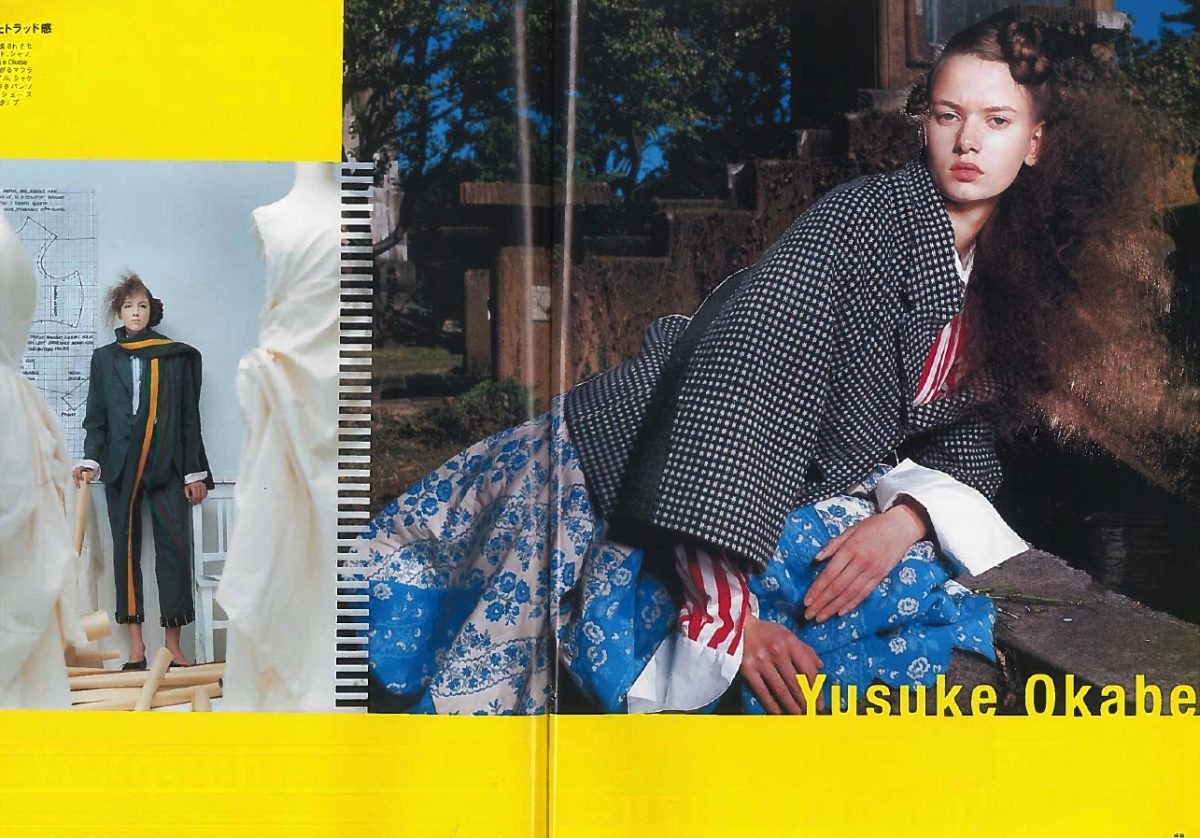
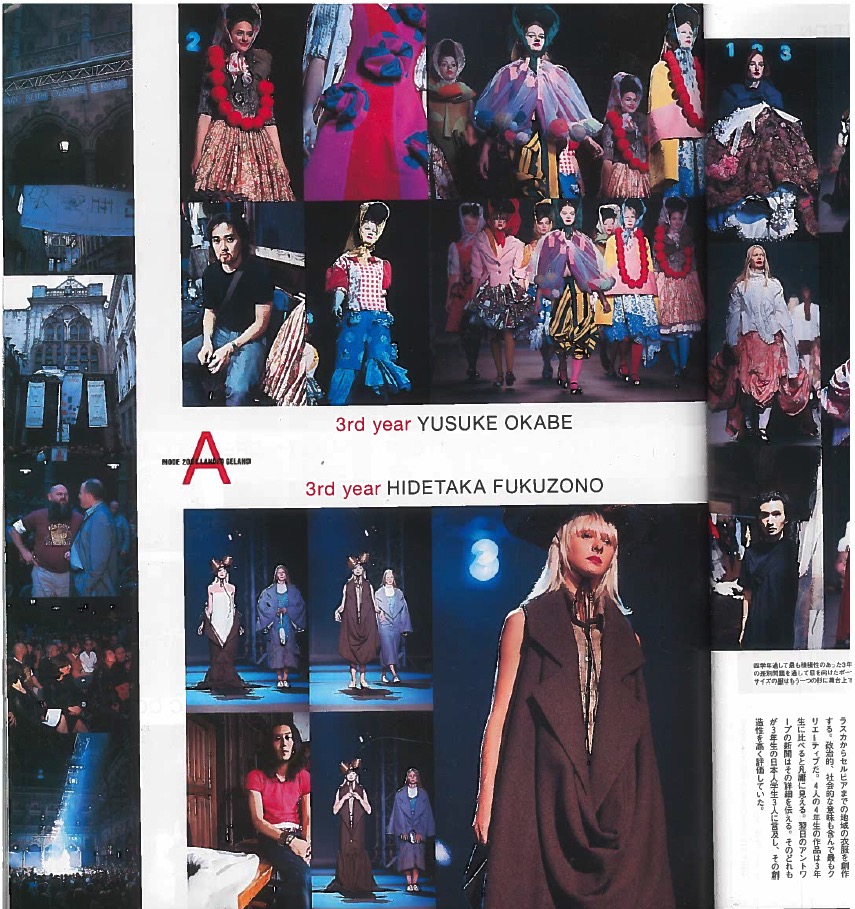 2000年頃、大学3年生のアントワープの日本人学生が取り上げられた雑誌の一部。岡部さんの他に、三人の日本人学生が居た。
 学生時代の作品のルックが日本の雑誌に取り上げられた。当時ベルギーのメディアにもインタビューされたらしい。