Essay
Fashion as a Social Phenomenon: Signification Accelerated by Digitalization
Yusuke Koishi, “Fashion as a Social Phenomenon: Signification Accelerated by Digitalization,” in Diversity and Creativity in the Digital Society: Gender, Media, Art, and Fashion, edited by Hiromi Tanaka, Kyoko Koma, and Osamu Takamine (Meiji University Press, 2023), ISBN 978-4-906811-33-5. Translated from the Japanese for KLEINSTEIN.COM.
1. What Is Fashion?
The word “fashion” drifts through the Japanese language with its meaning left ambiguous. In Japan it is sometimes translated as ryuko, or trend. Yet from the standpoint of someone who works in fashion, a trend is only a projection of one phenomenal aspect of fashion. What, then, does the word fashion encompass, and what does fashion design mean? I would first like to consider a Japanese translation that corresponds more closely to the reality of the phenomenon.
As a suggestive point of departure, consider a conversation held in Tokyo in 1998 between the architect Arata Isozaki and the artist Shusaku Arakawa.1 At the time, the New York-based Arakawa was producing architectural works with his partner, the poet Madeline Gins. Their exchange with Isozaki included a revealing discussion of what “architecture” means. In many lectures and books, Isozaki addressed the word’s original scope. In Japanese, architecture is generally understood as the design and construction of buildings, or as their style. Yet from a contemporary perspective, “architecture” exceeds the framework of placing a building as a structure within a city. It concerns not only buildings in physical space, or the city as an aggregate of buildings, but also the interactions and dynamics that arise between people and the urban environment.
1 More than twenty years later, the conversation between Isozaki and Arakawa remains deeply suggestive. It was collected in InterCommunication and is available through NTT ICC HIVE: “To Construct a New Landscape of Japan, Change Common Sense, and Create a Space for Everyday Life,” a conversation between Shusaku Arakawa and Arata Isozaki, moderated by Keiji Nakamura, March 6, 1998. hive.ntticc.or.jp/contents/artist_talk/19980306.
Arakawa’s concern was what he called “the architecture of life.” To change the world, he argued, it was necessary to remake the ethics of the human beings who constitute it. To make that possible, the human body would have to change; and to change the body, it would be necessary to design the architecture in which people live. In projects including the Reversible Destiny Lofts Mitaka, his true scope was not the architectural object standing in a landscape. It was the way that building would influence future human behavior and dynamics: the design of the phenomenon itself.2
2 An early form of this idea appears in the process-planning discussion in Arata Isozaki’s Space To (1971), and later in interviews including Isozaki and Naohiko Hino (2014). Isozaki and Arakawa did not agree on everything, but both approached architecture as a system rather than merely an object. Their attention was directed toward acts by which a system perturbs society.3
3 I understand Arakawa to have described this as “architecting life.” See Naohiko Mimura and Takashi Kadobayashi, eds., Arakawa + Gins in the 22nd Century: The Experience and Body of Reversible Destiny (2019).
2. Class and Fashion: The Birth of Yosou
Let us return to fashion. Just as architecture has architects, fashion has fashion designers. Are they people who make clothes? Or people who make trends? In light of Isozaki’s and Arakawa’s expanded understanding of architecture, it would be far too narrow to regard fashion as nothing more than clothing or trend.
Consider clothing, including accessories, as one of fashion’s principal elements. Imagine an era in which social class was rigidly fixed. The world before the eighteenth century offers a simple model. From a person’s combination of clothes and behavior, it was possible to identify their class or community with considerable accuracy.
What could clothing reveal? Signs, colors, and forms attached to a garment could indicate a person’s occupation or affiliation. Rare materials and structural complexity suggested the cost of production. The labor required to put on a garment – including clothes that could not be donned alone – disclosed the likely presence of servants. A mark showing that a garment had been produced in a particular place could indicate that its wearer had at least traveled there. Clothing expressed part of a person’s everyday pattern of action and thereby narrowed the social class to which they were likely to belong. The “surface” of appearance represented the person to a significant extent.
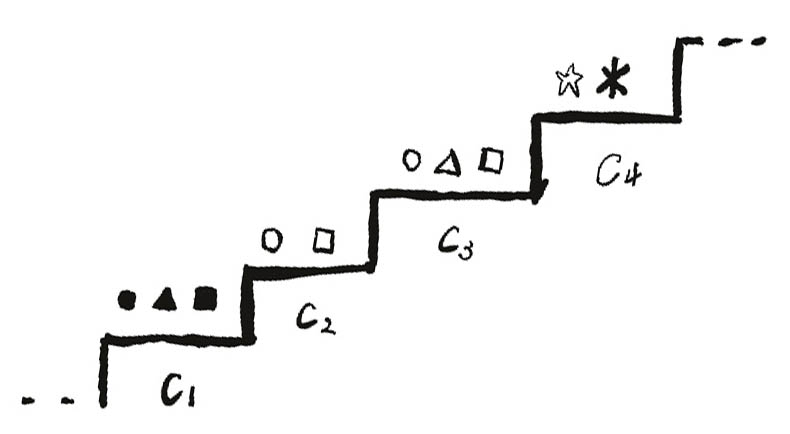
In a time when mobility between people and classes was low, and patterns of behavior were constrained by tacit institutions almost as binding as law, appearance functioned as the “uniform” of each community. It visualized the social institution and, viewed through the linguistic dimension of fashion, constituted a Saussurean langue.
A fixed society forms a staircase of social layers. Bong Joon-ho’s film Snowpiercer provides a vivid image. The passengers have boarded a train to survive a devastated, frozen Earth, and each door between its carriages divides them by class – in clothing, food, and entertainment. A glance at what a resident is wearing tells us immediately which class of carriage they inhabit.
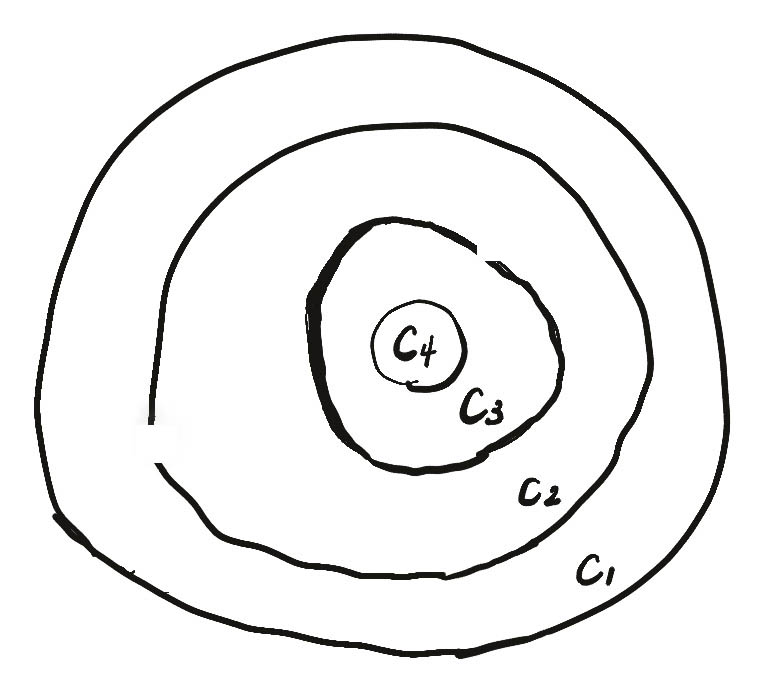
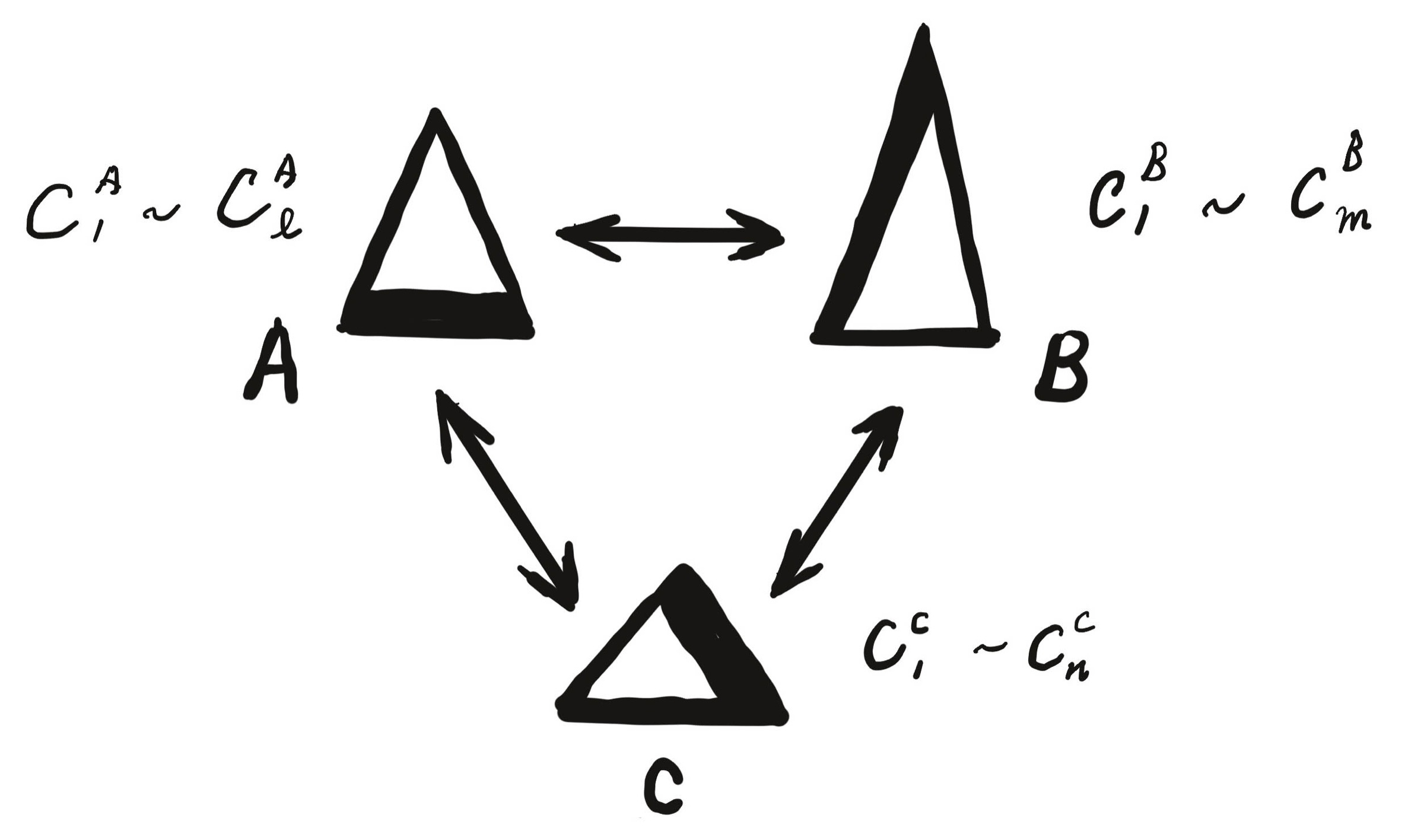
In reality, however, affiliation and condition are determined not by a single element but by combinations of elements: codes or rules, including customs that have never been written down. Suppose that four social classes or communities exist: \(C_1\), \(C_2\), \(C_3\), and \(C_4\). In a society where the mobility of people and objects is extremely low, the attributes of a person \(h\) make it relatively self-evident that \(h\) belongs to \(C_1\). This may be inferred from the fact that the clothing \(v\) itself belongs to \(C_1\): if \(v\) belongs to \(C_1\), then the person wearing it, \(h(v)\), is taken to belong to \(C_1\). Language and behavior, as well as clothing, adhere to class.
Now suppose that a garment \(v\) no longer belongs exclusively to \(C_1\), but appears across \(C_1\), \(C_2\), and \(C_3\). Clothing alone can no longer establish that \(h(v)\) belongs to \(C_1\). We instead identify the individual by bringing in further attributes \(x_1, x_2, x_3, \ldots, x_n\), and judge that \(h(v, x_1, x_2, x_3, \ldots, x_n)\) belongs to \(C_2\).4 In practice, we judge things through codes in which multiple elements intertwine: the combinations \((v_1, a, b)\) and \((v_2, c, d)\) may indicate \(C_1\), whereas \((v_1, c, d)\) and \((v_2, a, b)\) indicate \(C_2\).5
5 For example, if a Twitter account follows both Donald Trump and Joe Biden, its political tendency may be inferred from the other accounts it follows. As discussed below, the world of data is also encompassed by fashion.
4 In a society with extremely rigid classes, only a few variables are needed; clothing \(v\) may be sufficient. Here the focus is simply the judgment of class. We cut one section through human society and replace class with a family \(C\); the argument would be unchanged under another framework, although class has particular importance in fashion. In more mathematical terms, if we try to represent a human being through many parameters, \(h\) can be replaced by the vector \(h(x_1, x_2, x_3, \ldots, x_n)\). “Judging” or “recognizing” \(h\) can be understood as introducing a norm. Measuring a person with a norm based on a particular variable amounts to taking that variable as a scale. If \(\lVert h \rVert\) falls within a region \(a < \lVert h \rVert < b\), the person may be treated as belonging to \(C_1\). From Barthes’s The Fashion System and his interviews, I sense a desire to construct this at a dynamic level, even if mathematical reduction was not his explicit aim. The theory was unrealized, but people are now evaluated in just this way online.
As an aside, the television drama The Americans (2013), created by former CIA officer Joe Weisberg, depicts a family of Soviet spies living undercover in Washington, D.C., during the Reagan administration. Elizabeth, whose real name is Nadezhda, and Philip, whose real name is Mikhail, pose as a married American couple running a travel agency. To pass as American they disguise every imaginable element: fashion, pop culture, classical education, and speech. Even their children do not know that they are Soviet. We know that all these elements, not clothing alone, help constitute the individual, and the series represents this with great precision. The unease felt by the FBI agent in the story emerges from details that their disguise cannot fully conceal – minute expressions of conduct and behavior.6
6 When something feels “out of place” or produces a sense of incongruity, there is an error in the combination. The spy couple continually catches up with society to minimize that error. Such errors have important implications for fashion design.
In mathematics, a system whose state changes over time is called a dynamical system. Fashion is, so to speak, a dynamical system of human appearance and behavior. The word includes the behavior of the relations and interactions between society and people. Instead of reducing it to trend, I propose a new Japanese translation: Yosou, written “様装,” combining the idea of modality or state of appearance with that of attire.
3. Rethinking The Fashion System: Wittgenstein’s Picture of the World and Roland Barthes
Roland Barthes’s The Fashion System must be addressed. Influenced by Nikolai Trubetzkoy, who suggested that clothing could possess linguistic characteristics, Barthes examined fashion through linguistics and published the culmination of that work in 1967. As an analysis of fashion – or Yosou – the book cannot, in my view, be considered complete by contemporary standards. To prevent his argument from collapsing, Barthes restricted his object of study to fashion as represented in magazines: the linguistic properties of photographs, captions, copy, and their combinations.

Barthes was criticized for that restriction. His defense is worth quoting:
“I limited myself to written description for two reasons, one methodological and the other sociological. … It would have been impossible to conduct a precise analysis had I moved indiscriminately from images to written descriptions, and from those descriptions back to observations made in the street. Since the semiological method divides an object into elements and redistributes those elements into formal general classes, it was advantageous to choose material that was as pure and homogeneous as possible.”7
7 Barthes, Œuvres complètes II, 1962-1967 (2002), p. 1312.

The first impasse is that there is no guarantee that the structure of fashion as a social phenomenon can be extracted from relations between the images and words printed in a magazine.8
8 Let \(F\) be the phenomenon of fashion, \(I\) the set of images written on the page, \(G\) the totality of codes for combining clothes, and \(L\) language. No isomorphism between the total combination \((I, G, L)\) and \(F\) is guaranteed. Everything represented through \((I, G, L)\) is generated from \(F\), so it is self-evidently smaller; analyzing the smaller set does not guarantee that it remains isomorphic when expanded globally. In broad terms, Barthes takes a set \(I\) of magazine images and, for each \(i \in I\), a set \(l\) of associated linguistic expressions. His study evaluates elements \(i_1\) and \(i_2\) through the relation between \(l_1\) and \(l_2\). Yet \((I, G, L)\) is not guaranteed to be isomorphic with the world. If an enormous number of image files and their associated linguistic expressions were evaluated through natural-language processing, a fashion system might become visible. This would resemble what companies such as Google and Baidu do through image analysis and language processing.
Yet the attempt to understand fashion through the language of fashion images has an affinity with the picture theory of the world in Ludwig Wittgenstein’s Tractatus Logico-Philosophicus. The work begins: “The world is the totality of facts, not of things.” If the world is W, it may be imagined as an infinite union of obtaining facts E:
From proposition 2.1 onward, Wittgenstein discusses the making of “pictures” from reality.9
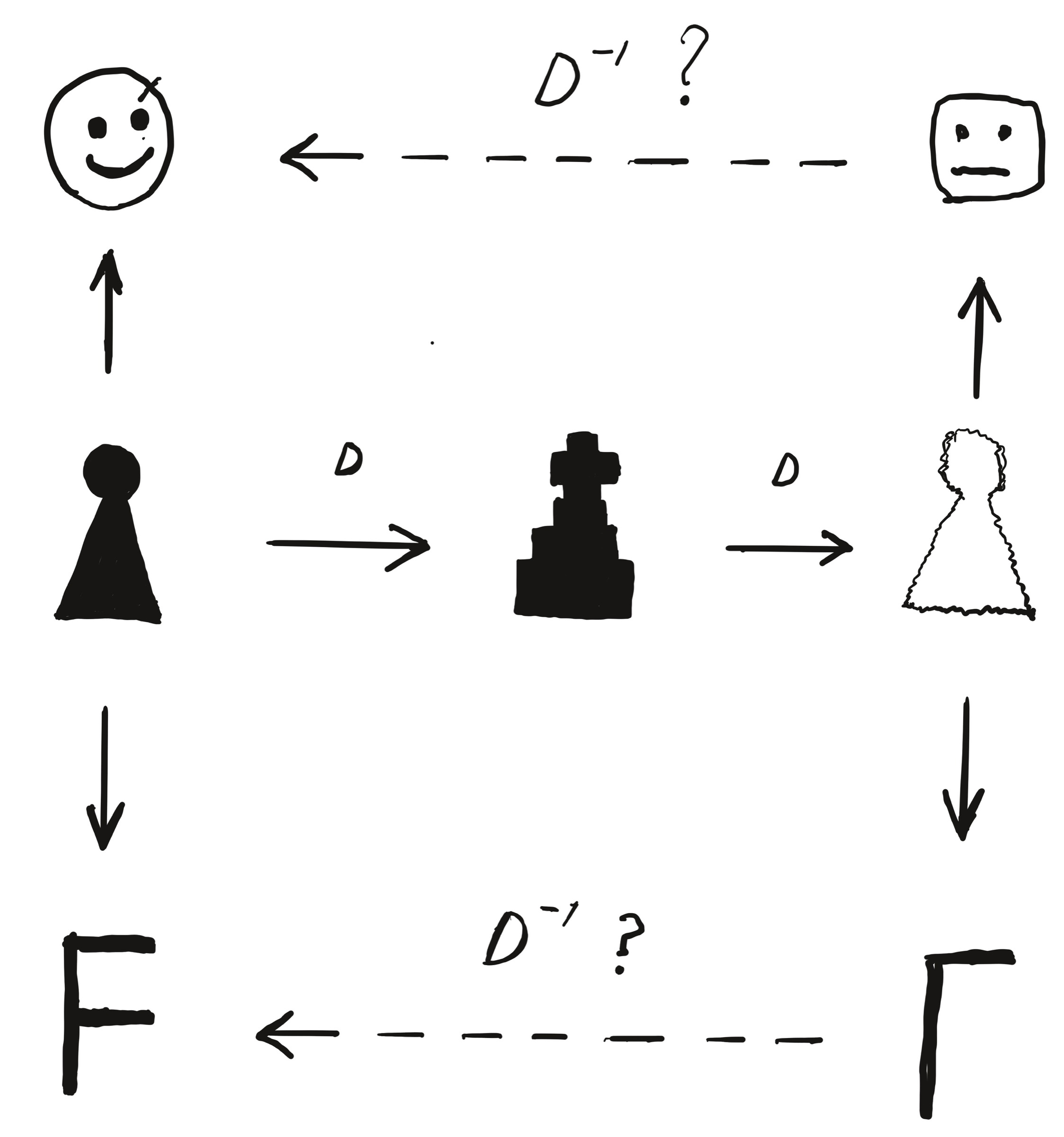
9 For Wittgenstein, facts are obtaining facts. He also defines “states of affairs”: what can logically occur as a possibility. Consider \(D(W)\), a picture produced by the operation \(W \Rightarrow D(W)\). It represents the world “in a certain form,” and any number of forms of representation are possible. The reverse operation, \(D(W) \Rightarrow W_d\), however, is not guaranteed to reconstruct the world.10 Barthes’s project is an attempt to understand the phenomenon of fashion through the linguistic logical structure of \(M(W)\), the image of the world transferred into the picture \(M\) of a magazine.
10 In propositions 4.012-4.013 of the Tractatus, music provides an example of reconstruction. A record, a musical thought, a score, and sound waves are related as pictures. Because they share logical structure, a composer can derive a symphony from a full score, or from a record, and a listener can derive the score from the symphony.
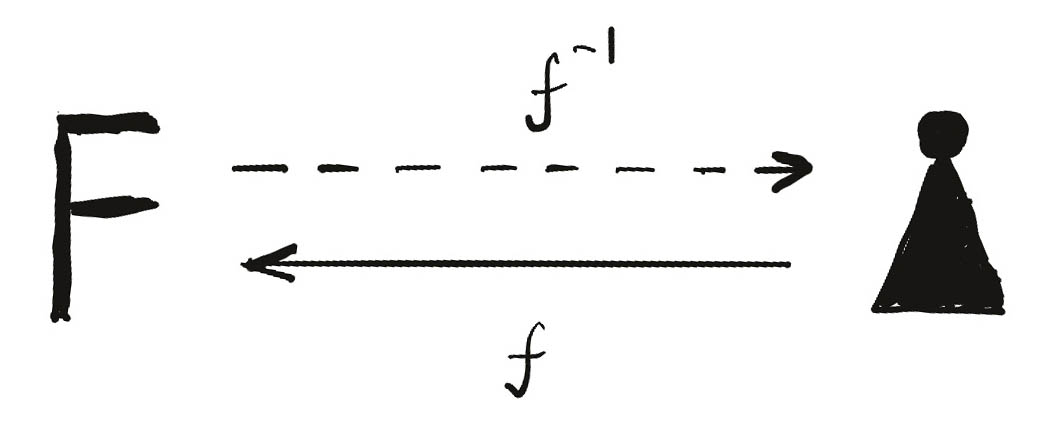
Barthes’s analysis may have functioned in a world whose class structure was fixed. Where clothing was less diverse and both the movement of objects and the volatility of value were low, the correlations among language, clothes, and Yosou were limited.11 In Barthes’s defense, the point of modeling also lies in exposing the events that a model cannot describe and the places where it breaks down.
11 Suppose that \(n\) garments exist in the world at a given time and that three are worn simultaneously. If one styling combines three garments, there are \({}_nC_3 = n(n-1)(n-2)/3!\) possible combinations. Let \(s(a,b,c)\) be the number of signifieds that can be associated with the garment combination \((a,b,c)\). The total number \(N\) of combinations between clothes and signifieds is \[ N = \frac{n(n-1)(n-2)}{3!} \sum_{i=0}^{n} \sum_{j=0}^{n} \sum_{k=0}^{n} s(i,j,k). \] \(N\) increases as the number of garments grows and may be treated as one measure of fashion’s complexity. Even clothing alone yields an astronomical number. In reality, signifieds arise from combinations involving words, places, food, music, social-media activity, books, age, height, skin color, and much more. Continuing Barthes’s manual analysis is therefore plainly impossible.
4. Introducing Time
We must not forget that fashion contains the concept of time. Barthes’s semiotic analysis remains unresolved because time is absent from it. A dynamic phenomenon cannot be captured through observation of a single period. A magazine merely samples groups of representations from a limited interval. The possible combinations of garments, words, and images increase over time. The difficulty of incorporating this temporal movement of society into semiotics marks a limit in the construction of fashion theory.12
12 This resembles Isozaki’s process-planning account of the dilemma of urban planning: from the moment construction begins, both the city and reality continue to change. The sets \(I\), \(G\), and \(L\) increase monotonically over time, as does the complexity of fashion: \(N(t) < N(t+1)\).
To take an extreme example, the meaning of the sign “MAKE AMERICA GREAT AGAIN” differs between Ronald Reagan’s 1980 campaign and the rise of Donald Trump in 2016. The meaning of the color red likewise differs before and after the socialist era. Meanings attached to garments and signs change with time.
Material quantities are not the only things that change. The meaning of human behavior, custom, and cultural preference changes too. We know from experience that an element distinctive to one community several decades ago may now belong to another. Hip-hop music, born in the South Bronx in the 1970s, is today embraced by broad generations and ethnic groups, not only African Americans, although its style originally formed a code within a particular community. Noh theater and tea were once rare cultural forms monopolized by specific classes; today they are far less useful for judging a person.
When a scarce object remains rare and nearly monopolized between classes, it forms a class barrier. Once that element begins to circulate through society, the barrier gradually loses its meaning. It is a social law that as rarity disappears, classes change from a staircase into a continuous slope.13
13 A related picture of the world appears in Ken Suzuki, A Smooth Society and Its Enemies (2013), which proposes concepts such as value-propagating currency and dividual democracy as means of smoothing boundaries.
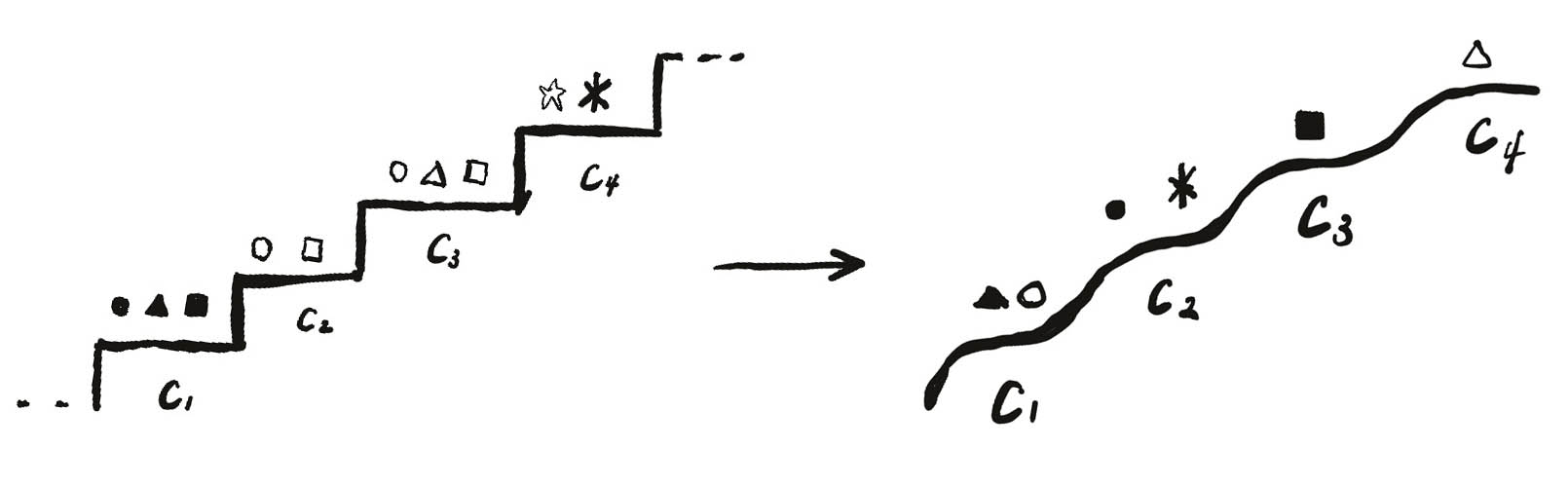
14 Secret societies such as Freemasonry and clubs within the American Ivy League offer clear examples.
5. Designing Yosou to Set Images in Motion: Fashion Design as Code Design
Having given fashion the name Yosou, let us reconsider fashion design. If a building in architecture corresponds to a garment in fashion, then fashion design can be understood by analogy with the broad architectural practice discussed by Isozaki and Arakawa. It is not simply the making of clothes. It is process planning whose scope includes the creation of human dynamics.
In a world where we read people through surface combinations of their attributes, could new combinatory codes introduce motion into society? Social codes arise and change dynamically through unspoken atmospheres between people and through processes of interaction. Could a fixed barrier between classes or communities be set in motion, then provisionally fixed again in another form?15
15 The concept of time \(t\) enters a combination of variables \((v, e, x)\), producing \((t, v, e, x)\). The dynamics generated by time form fashion’s essential meaning. If periodic laws appear in the changing pattern of \((t, v, e, x)\), it is understandable that we might call them trends. Yet it is the movement itself that should be defined as fashion, or Yosou. Here \(t\) is time, \(v\) clothing, \(e\) environment, and \(x\) other elements.
Consider Chanel. An orphan from the lowest reaches of the social order, she began her career by making hats for customers above her own class and came to prominence after the Spanish influenza pandemic. Her designs are usually discussed in terms of women’s liberation. Yet she also created designs from materials associated with underwear and from imitation pearls, then sold them to wealthy customers. Seen this way, her theme could be described as the confusion of hierarchy through the circulation of objects and styles. Making an element native to one class or community cross several classes, and breaking codes of appearance that had been paired with class, unsettled social dynamics. Fashion design also creates new communities outside established hierarchies and gives each a new ordering, making direct comparison with the old hierarchy difficult.16
16 Set theory makes this easier to arrange. Let \(H\) be a set of human beings \(h_1, h_2, \ldots, h_n\). Define some distance \(d\) between each \(h\); it can be arbitrary, for example the distance between a person’s home and the Kyoto Imperial Palace. The pair of people and distances creates the metric space \((H, d)\). Human society has many scales, so introducing a different metric \(d_{\mathrm{new}}\) changes the hierarchy of the set. Constructing that new metric is one function of fashion design. More abstractly, however, fashion design introduces a topology, and the dynamics of that topological space are what I call fashion, or Yosou.
18 Marx said that the history of all societies is the history of class struggle. I understand Chanel’s experiment as a hacking of class.
Fashion is not limited to the material object of clothing. When the symbolic force of objects was especially strong, object design held extraordinary meaning. But knowledge and thought can also become fashion, or Yosou. Examples include the explosive popularity of French contemporary thought in the United States during the 1970s and the circulation of postwar contemporary art.17
17 By coincidence, Fashionable Nonsense is the title of Alan Sokal and Jean Bricmont’s critique of French contemporary thought. François Cusset’s French Theory describes how French theory was used as a code in American society. Laura de Coppet and Alan Jones’s The Art Dealers is also valuable for understanding how contemporary art generated new communities and how owning art became fashionable.
Innovation in fashion has emerged by proposing combinations of codes that do not yet exist – in semiotic terms, by generating multiple acts of parole that rewrite langue. In terms of form, from Balenciaga, Dior, and Chanel through the turn introduced by Comme des Garçons and Martin Margiela, it has repeatedly been said that the possibilities of bodily clothing have been exhausted. Many styles have indeed arisen, attached themselves to social scenes, become uniforms, and ultimately been absorbed as new categories. The creations of fashion design are projected as images into media, boutiques, department-store zones, and the merchandise classifications of online shops. They are entered into the dictionary of fashion as new vocabulary.19
19 The business reality of fashion resembles a coordinate plane whose x-axis is marked by established categories – punk, avant-garde, and so on – and whose y-axis records the price range of products and images. Once a design is born, market forces plot it somewhere on this plane. The creation of a new style has been understood as landing on a previously unclassifiable point.
What is novelty in fashion? In a Wittgensteinian picture of the world, it is nothing other than realizing a set of possibilities not yet established as facts – states of affairs – and using that noise to perturb the present langue of fashion.
We encounter music, clothes, accessories, and objects, then discuss their structures, beauty, function, and meaning. Once time is included, however, we should also consider the future produced by making them. Objects influence people and generate new movements; those movements in turn prompt the birth of new objects. Fashion design is “designing in-distance”: design that reaches far enough to perturb a phenomenon.20
20 In this context, fashion is not limited to making clothes in the narrow sense; making music or religion can also fall within its domain. Let the “state of the world” at time \(t\) be \(A(t)\). Its development may be represented as \[ A(t+\delta t) = P(t)A(t), \] where \(P\) is the total perturbation produced by all actions upon \(A\): everyday life, statements, accidents, and natural disasters. To make something and affect the world is to modify an element within \(P\) and thereby influence the temporal development of \(A\). A tendency in that development may appear, in fashion’s vocabulary, as a trend.

6. Counterculture as a Perturbation Born from the Environment
When considering the combination of codes in contemporary fashion – time, clothing, environment, language, and other elements – there have been many scenes in which the weight of the social environment exceeds the variety of clothing itself.21 In the terms developed above, counterculture in fashion is the emergence of meaning through new code combinations when the environment carries exceptional weight.
21 The Trump administration generated many countercultures. For four or five years, sustainability and diversity functioned as anti-authoritarian forms. The countercultures of the 1960s and fashion scenes after the 1970s were strengthened by postwar upheaval, the Nixon administration and Vietnam War, the opposition between communist Eastern and Western blocs, and wider social anxiety.
Consider the simple act of wearing a cap printed with “MAKE AMERICA GREAT AGAIN.” Literally, the words mean nothing more than making America great again. In the presence of former president Donald Trump, however, that literal sense recedes. Combined with the cap and the representation of the color red, the slogan became, for many politically liberal observers, an icon of anti-diversity and anti-liberalism. When a “strong sign” supports an image, the image’s original meaning becomes governed by it. During the Trump administration, support for liberalism, diversity, environmental protection, and gender freedom could itself function as a counterforce and a symbol of resistance to power.22 Social power becomes the object of opposition and a catalyst that generates new codes, signifiers, and signifieds.
22 Ronald Reagan originally used “Let’s Make America Great Again” in 1980, although many people no longer remember it. After Vietnam and amid the Cold War, “make America great again” may have sounded different. DAZED STUDIO’s June 2020 report The Era of Monomass named Donald Trump among the most influential figures, ahead of Kanye West and environmental activist Greta Thunberg. See also Koishi (2021).
7. Fashion in a Society of Accelerating Signification
Since the COVID-19 pandemic began in 2020, the digitalization of the world has accelerated. With that reality in view, we can reconsider the possibility of The Fashion System. Human appearance and norms of conduct are now more diverse, and the boundaries of communities more dynamic. Signs are polysemous, and the meanings suggested by the codes of Yosou generated through their combinations are dynamic as well. People have begun to possess several faces depending on time and place, establishing themselves as dividuals.23
23 For discussion of dividuality – being A while also being B – see Suzuki (2013).
“Nosedive,” the first episode of season three of Black Mirror, portrays a world in which every person is assigned a social score. Characters are rated through their everyday conduct, and the system uses those scores to decide where they may live and whether they may travel abroad. In this digitalized world, human existence is mathematically cut out and processed. In one sense it is not so different from the world before the eighteenth century, when human attributes were judged almost mechanically. We are being re-signified as patterns of data. This is the destination of a fashionable dystopia; five years after the episode was made, parts of that fiction had begun to be implemented in reality through the pandemic.
Recall the semiotic analysis – or classification – attempted by Barthes. His project remained unresolved because it tried to analyze the phenomenon of fashion through images in the limited medium of the magazine. What if the object of analysis were expanded to all text and image data in digital space? Data continues to be recorded as a time series. If a dynamic semiotics capable of temporal development arose here, a true Fashion System might become visible inside the digital dystopia. When the complexity of the world N is sufficiently large and the number m of digitalized points is also sufficiently large, we may in principle assume:
Fashion’s most decisive innovations have emerged as the immobility of fixed rules and fixed classes collapsed. Fashion was born as a revolutionary apparatus for hacking a discrete world that treated people as signs, in a time when they could not choose their own appearance or way of life. New forms of appearance hacked society’s tacit codes and the fixed values attached to them, blurring the boundaries of communities. By gradually gathering people who identified with a style, they made new hierarchies. Innovation emerged by separating communities from one another or connecting them anew.
Today, digitalization cuts reality into a discrete mesh that approaches continuity. In an era when almost everyone can choose their clothes and, to some extent, their way of life, what would count as a new fashion innovation? It would be a hack that deliberately renders mechanically calculated reality incalculable. If we enter a simulated world in which the digital image \(D(W)\) is recognized as the world itself, then creating another digital image \(D’\) through which to project the world will be one form of design.24
24 In this sense, media such as Instagram and Weibo can themselves be understood as new fashion designs. Generating a sequence of fashion codes \((x_1, x_2, \ldots, x_n)\) through fashion’s existing framework, and thereby prompting the formation of a new digitalization \(D”\), will surely be another.25
25 Tadao Umesao once proposed a viral theory of religion. Given fashion’s religious dimension, innovation might arise from the idea of “making a virus.” I discussed this point in Koishi (2016).
You live wherever you live, you do whatever work you do, you talk however you talk, you eat whatever you eat, you wear whatever clothes you wear, you look at whatever images you see … You’re living however you can; you are whoever you are.
“Identity” – of a person, of a thing, of a place. “Identity.” The word itself gives me shivers. It rings of calm, comfort, contentedness. What is it, identity? To know where you belong? To know your self-worth? To know who you are? How do you recognize identity? We are creating an image of ourselves; we are attempting to resemble this image. The accord between the image we have created of ourselves and … ourselves?
Just who is that, “ourselves”? We live in the cities. The cities live in us. Time passes. We move from one city to another, from one country to another. We change languages, we change habits, we change opinions, we change clothes, we change everything. Everything changes. And fast. Images above all.
Wim Wenders speaks these words at the opening of Notebook on Cities and Clothes (1989), his film featuring Yohji Yamamoto. Fashion is not confined to clothing or trend. It is the larger social modality – the dynamics – through which the state of human appearance changes and finds expression. Our identities bleed outward beyond the individual and into society. The correlation between individual and society supports identity and endlessly generates new images, new relations between signifier and signified.
I want to state once more that this text was written to give the image and name “Yosou” to fashion, a word that had not yet found an adequate Japanese translation. I end in the hope that the concept will continue to develop.
Acknowledgments
I am grateful to Shingo Emoto of Shoyosha for his feedback on several of the calculations in the notes.
References
- Arakawa, Shusaku, Arata Isozaki, and Keiji Nakamura, moderator. “To Construct a New Landscape of Japan, Change Common Sense, and Create a Space for Everyday Life.” March 6, 1998. NTT ICC HIVE.
- Barthes, Roland. Œuvres complètes II, 1962-1967. Paris: Éditions du Seuil, 2002.
- Barthes, Roland. The Fashion System. Japanese translation by Nobuo Sato. Misuzu Shobo, 1972.
- Barthes, Roland. Collected Writings on Fashion. Japanese edition supervised by Toyoko Yamada. Chikuma Shobo, 2011.
- Cusset, François. French Theory. Japanese translation by Kohei Kuwada, Teppei Suzuki, Tatsu Hatakeyama, and Takahisa Honda. NTT Publishing, 2010.
- DAZED. The Era of Monomass. 2020.
- de Coppet, Laura, and Alan Jones. The Art Dealers. Japanese translation by Tetsuo Kinoshita. PARCO Picture Backs.
- Isozaki, Arata. Space To: Thought Returning to the Origins. Kajima Institute Publishing, 1971.
- Isozaki, Arata, and Naohiko Hino. Arata Isozaki Interviews. LIXIL Publishing, 2014.
- Koishi, Yusuke. “Fashion, Discretized Human and Its Modality.” ÉKRITS, October 20, 2016.
- Koishi, Yusuke. “ACTION TO TAKE NEXT: The Next Landscape of Mode as Seen from the Non-Western World.” Harper’s BAZAAR Japan, March 2021.
- Suzuki, Ken. A Smooth Society and Its Enemies. Keiso Shobo, 2013.
- Wenders, Wim, director. Notebook on Cities and Clothes. Axiom Films, 1989.
- Wittgenstein, Ludwig. Tractatus Logico-Philosophicus. Japanese translation by Shigeki Noya. Iwanami Shoten, 2003.