Magazine
FREE MAGAZINE ISSUE#6 “Everyone Is in Need of a Dark Space Again”
Originally published by FREE MAGAZINE. English translation prepared for the KLEINSTEIN TEXTS archive.
I think it was about five years ago. On the way from Shinjuku Station toward Kabukicho, I saw an elderly homeless man wearing a black Adidas jersey top with three gold stripes down the sleeves and a pair of faded blue jeans. On his feet were brown vinyl sandals of the kind one used to find in the toilets of old provincial inns, the sandals commonly called “benjo sandals.” The brown of those sandals had an atmosphere no artificial processing could reproduce, and it strangely matched the blue of his faded jeans. His hair was long and unkempt, a mixture of white and black; his skin was darkened; a tension floated in his narrow eyes. I remember thinking that living as a person of the street might almost be an occupation necessary for actually ruling the street. His figure is still burned into my memory, and whenever I pass along the same road I sometimes regret that I never photographed him. The words street fashion and street style are used everywhere as if they were self-evident, but every time I see or hear them, the image of that homeless man and the city of Shinjuku rises in my mind like a curse.
In Wim Wenders’s 1989 documentary on Yohji Yamamoto, Notebook on Cities and Clothes, there is a scene in which Yamamoto opens a photography book. The book is August Sander’s People of the 20th Century, a collection of portraits of ordinary people in Germany, then the Weimar Republic, from the first half of the twentieth century. The work is divided into seven sections: “The Farmer,” “The Skilled Tradesman,” “The Woman,” “Classes and Professions,” “The Artists,” “The City,” and “The Last People,” which includes homeless people and veterans. Beneath each portrait is the subject’s occupation. Perhaps because photography was still rare, every subject has a slightly serious expression. Yet strangely, in each person, occupation, clothing, face, and atmosphere coincide to an uncanny degree. In the film Yamamoto says, “When I look at people in the city today, there are many whose occupation I cannot tell. But each person in these photographs seems to have a face that belongs to that person.” Wenders shows the “Gypsy Youth” in the book and narrates, “I think this gypsy is his favorite. Not only the clothes, but the look in his eyes, the way his hands are in his pockets.”
Let us return to the street. The prototype of what is now called street fashion began to take tangible form and become recognizable around 1967 in Britain, when John Dove and Molly White11From 1966 to 1967, John Dove and Molly White developed their own textile ink and created “Painless Tattoo,” a collection of innerwear printed with tattoo motifs by silkscreen. Their later works became one of the sources of punk fashion. silkscreened pop art onto clothing. Various messages that had previously been confined to canvases and posters were printed onto T-shirts, which had originally been nothing more than underwear. Fashion thereby gained an item through which a message could be sent by itself. If we exclude religious or ethnic dress, style had once been formed, as in the era Sander photographed, through the balance between combinations of garments, a person’s atmosphere, facial expression, behavior, and occupation. But through the act of “wearing signs” such as printed words, images, and photographs, style was compressed into message, and anyone could easily express themselves through clothing. Early rock-and-roll singers such as Elvis Presley, followed by Iggy Pop, the Beatles, the Rolling Stones, Patti Smith, and many other singers, artists, and figures of the moment, functioned as influencers for this newly born fashion. Street fashion gradually began to hold strong meaning within mass culture. Young people could now show rebellion by wearing clothes printed with the word “REBEL,” or send a message by wearing garments printed with an artist’s portrait or by imitating that artist’s style. Young people who did not have the means to express themselves through singing or making things could now express themselves simply by wearing clothes. It was probably around this time that the center from which unfamiliar messages, strange to the eyes and ears of adults, were emitted came to be recognized as the “street.” For this reason, street fashion is often used almost synonymously with youth fashion. But that diminishes the street’s more fundamental origin.
For fashion, the “back street” once meant Africa, Asia, and other things that appeared exotic from Europe and America. Yves Saint Laurent sought raw material for the unfamiliar in Africa and China, while Kenzo Takada brought unfamiliar Japanese textiles into Europe from the position of a stranger. These things briefly captured the hearts of people who wanted to wear something different from others and be different from others, though not too radically different. But once they were consumed and became familiar, their exoticism disappeared. In this way people are always searching for a danger they have not yet grown used to. Not something entirely unseen, but something that can be seen only by taking a small risk. Somewhere in daily life, they search for a sharpened tension that cannot be found in familiar scenery. By wearing something born from a world that should ordinarily have had nothing to do with them in the visible world, people have sent the message that they want to be different from others. Yet it is strange: human beings create something new, and once it becomes fashionable, they begin to distance themselves from it. The sharp messages of minorities, when emitted by many people, are swallowed by waves of consumption, gradually lose their original edge, and ultimately are digested by the mainstream as a mere accent of “difference.” Ironically, the attitude that refuses the mainstream leads to subordination to a community of people who refuse subordination. And people begin to search for a new place, like hunters setting out for a new continent.
Where is the street now? Shoreditch in London, Alphabet City and Queens in New York, South Central in Los Angeles, Kreuzberg in Berlin. In the streets of major cities, the atmosphere of the main street has begun to flow in little by little, and they are gradually ceasing to be back streets. The raw stones of style found there are mined, consumed, and popularized. Those who are no longer satisfied with the air of a mixture of front and back continue searching for the air of a new back street. Seeing Cyrillic letters dance through fashion for the last two years, and watching styles based on the youth cultures of the former Soviet Union and Eastern Europe appear on runways, I sometimes think the West may already have consumed all it can from the street. It may only be a matter of time before the streets of the East, too, are fully exposed to the main street and consumed completely.
In literature, style means prose style. In fashion, style is something like a modality that emerges between the patterns of dress belonging to the community to which a person belongs and the habits that seep out from deep inside the individual body22A more detailed discussion related to Roland Barthes appears in the author’s earlier ÉKRITS essay “Fashion, Discretized Human and Its Modality.”. If a human life is something like a novel, then the desire to be different from others and the desire to wear the air of the non-everyday “street” must also be bound to contexts born from past events in each life. The clothes we wear now, like a sentence written in a novel, influence our future and our modality of being. Style drifts between past and future. Now that everything is becoming something already seen, it may be time to think about what it means to make style. I would like to end by quoting the narration that opens Wenders’s Notebook on Cities and Clothes.
YOU LIVE WHEREVER YOU LIVE,
YOU DO WHATEVER WORK YOU DO,
YOU TALK HOWEVER YOU TALK,
YOU EAT WHATEVER YOU EAT,
YOU WEAR WHATEVER CLOTHES YOU WEAR,
YOU LOOK AT WHATEVER IMAGES YOU SEE,
YOU’RE LIVING HOWEVER YOU CAN,
YOU ARE WHOEVER YOU ARE.
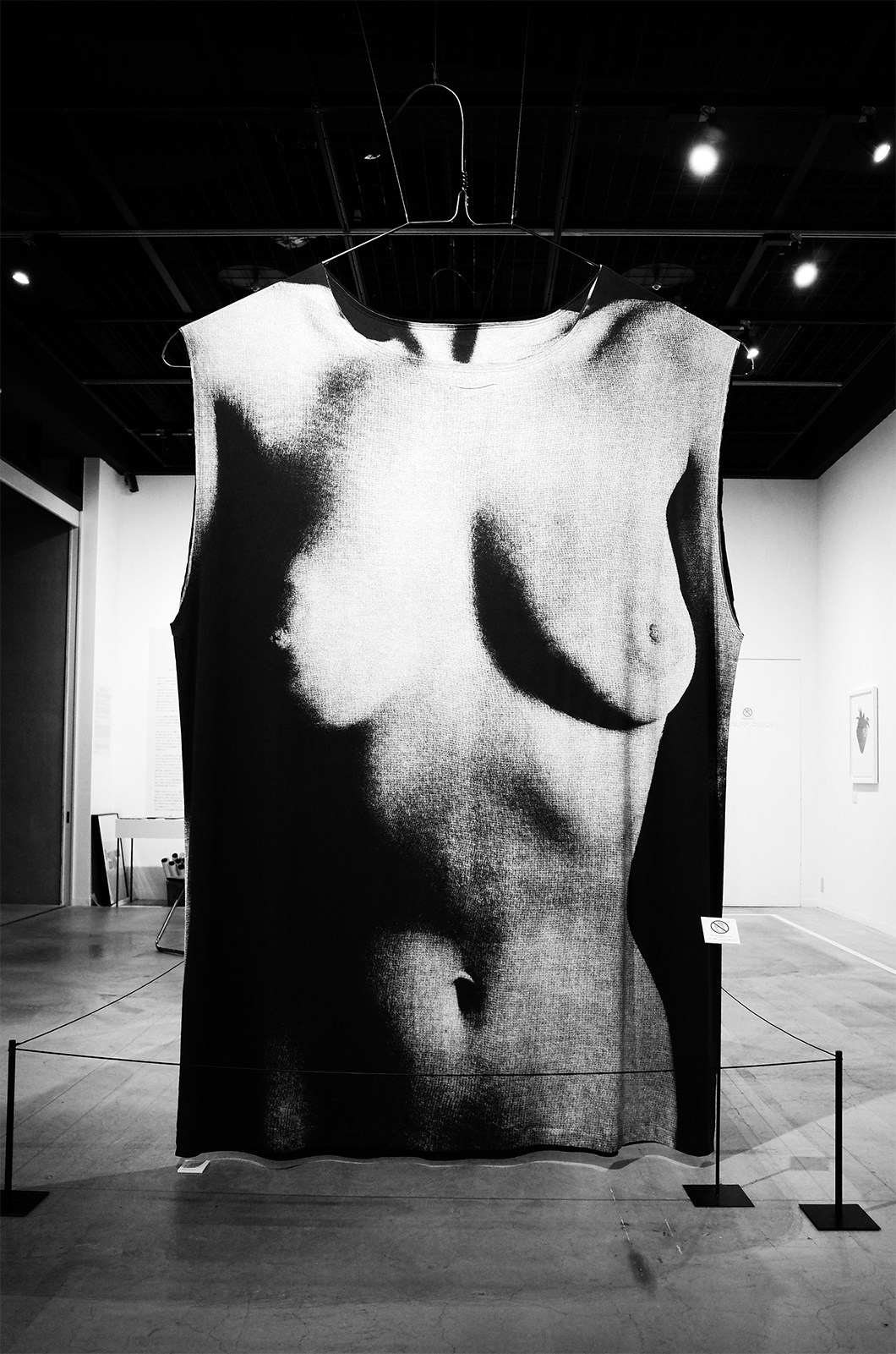
BIG BREAST T-SHIRT BY JOHN DOVE AND MOLLY WHITE AT “SENSIBILITY AND WONDER” EXHIBITION AT DIESEL ART GALLERY, TOKYO JAPAN (2017) PHOTOGRAPHY YUSUKE KOISHI
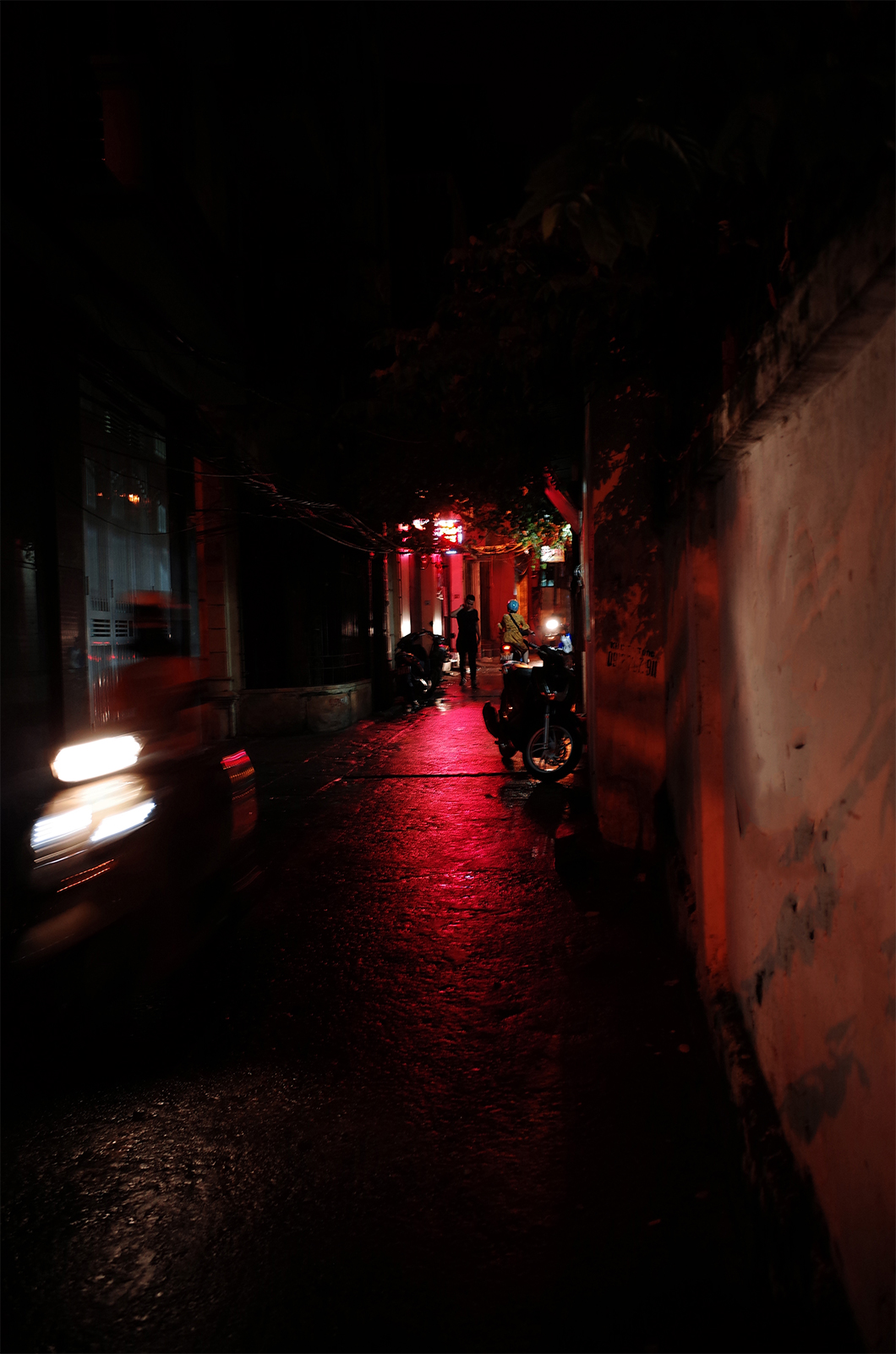
BACK STREET (2017) PHOTOGRAPHY YUSUKE KOISHI