Interview
Interview with Ben Fino-Radin (Small Data Industries): Digital Preservation and Media Conservation, Part 1

The author worked for more than ten years, from 2004 to 2015, as an archivist at NTT InterCommunication Center [ICC]. In autumn 2015, through the Agency for Cultural Affairs’ Program of Overseas Study for Upcoming Artists, I went to New York to conduct research at museums and related institutions that had been pioneering digital preservation and media conservation (11This mainly refers to the digital preservation, protection, and conservation of works using media and moving images in the field of art, time-based media art, and artistic records.) in the arts. At the time, academic discussion around archives was increasing in Japan, but one reason I undertook the research was that I felt there were still few opportunities for practitioners like myself, who actually handle media and equipment in daily work, to share knowledge, practical know-how, and problems with one another. I first selected institutions to visit, including the Metropolitan Museum of Art, the Museum of Modern Art (MoMA), the Whitney Museum of American Art, the New York Public Library for the Performing Arts, the New York Philharmonic, Anthology Film Archives, and Rhizome, and then looked for the people responsible for this work at each institution. I visited them and conducted interviews, while filming video documentation, about current conditions, problems, and challenges, including past examples and future possibilities or predictions from the perspective of media archaeology. The research report I submitted to the Agency for Cultural Affairs at that time has been made public, and I encourage interested readers to take a look.
About six years have passed since then. How are those people engaging with archives today? For this interview, I spoke with Ben Fino-Radin, one of the people I interviewed in 2015, who at the time was working in media conservation at MoMA.
Ben is a well-known and highly regarded figure among art professionals in New York. During my 2015 research, many people brought up his name. After working at MoMA for about four years, Ben founded his own company, Small Data Industries (hereafter Small Data), in New York in 2017. Today, with museums and artists as clients, Small Data provides services according to need, including the restoration and digital preservation of time-based media art and other artistic records, as well as consulting related to those areas.
So far, he has digitized the wide-ranging archive of the artist Louise Bourgeois and carried out a project commissioned by the Whitney Museum of American Art (hereafter the Whitney), which I will introduce later. With Cooper Hewitt, Smithsonian Design Museum (hereafter Cooper Hewitt), he has been continuing a project for digital collections for five years.
I asked Ben, who has found a path beyond working within the single framework of the museum, in detail about Small Data, which he founded in 2017: the projects he has undertaken, the projects he is currently working on, and his plans for the future.
The Founding of Small Data Industries
When people hear the word archive, many may imagine work carried out inside libraries or museums. Ben himself was in fact active as an associate media conservator at MoMA (22One of the works Ben was researching in 2015, when he was in MoMA’s media conservation department, with a view toward restoration and preservation was Teiji Furuhashi’s LOVERS: The Lovers (1994). The work was shown in the 1995 exhibition Video Spaces: Eight Installations, curated by Barbara London at MoMA, and after Furuhashi’s death in 1995 it entered MoMA’s collection in 1998. At the time, MoMA had no media conservator, information about the work was limited, and for a long period it had not been activated in an appropriate form. However, a student in a class Ben was teaching was researching the work, and documentation proceeded with an eye toward future exhibitions and preservation. The computer used in the work was made in 1993, and MoMA did not possess the source code for the program that ran it, but through reverse engineering they succeeded in writing out the program’s contents into general documentation. The work reportedly proceeded while seeking feedback from other members who had founded Dumb Type together with Furuhashi, so that the work could be activated and exhibited in the future. Ben Fino-Radin, “Art In the Age of Obsolescence: Rescuing an Artwork from Crumbling Technologies,” MoMA, Features and perspectives on art and culture, December 22, 2016. https://stories.moma.org/art-in-the-age-of-obsolescence-1272f1b9b92e#.84pjt48ab). During his time at MoMA, he also had experience co-developing open source software for the preservation and management of digital artworks with Artefactual Systems, the developer known for the open source digital preservation system Archivematica.
Around the end of 2016, when Ben was approaching his fourth year at MoMA, many museums and galleries besides MoMA needed specialized knowledge concerning the digital preservation and conservation of artworks. Artists also sought access to that knowledge. Around that time, Ben had already begun accepting consulting work on the side and was simultaneously working on projects for the Whitney and the Dia Art Foundation, known for Dia Beacon. Ben realized that, rather than working in a fixed role within the structured environment of a large museum, project-based freelance work allowed him to be more directly involved and felt more rewarding. It also made it possible to provide more flexible support across professional boundaries, helping art-related clients of every scale and form address concrete problems and achieve their goals.
At just that moment, Cooper Hewitt announced a call for a large-scale grant project that included survey and research of its collection. The project was large enough to pay collaborators, and it involved formulating a long-term strategy for digital curation and preservation, exactly the kind of project in which Ben’s experience and abilities could be put to maximum use. As if pulled by the force of fate, Ben applied. Fortunately, his proposal was accepted, and he left MoMA. Once he launched the Small Data website and began sharing information, demand appeared immediately, just as he had expected. He has been busy from the very day he started the company.
The Form of Small Data Industries
After founding Small Data, Ben has changed its scale and form as needed. For conservation and consulting work, he focuses on a small number of high-end clients, and he largely manages and responds to them himself. The reason he currently focuses on a small number of clients is that he wants to accomplish denser and deeper work, both for the clients and for himself. Rather than aiming to expand the business rapidly in the short term like a startup, he wants to concentrate on work that is meaningful for the company.
However, the larger a project becomes, the harder it is to advance rapidly alone. Anyone who has ever been involved in building an archive can easily imagine this: it takes time and involves steady, painstaking work. In particular, it requires diverse forms of knowledge, including an understanding of multiple kinds of software and old hardware, and it demands training comparable to learning a musical instrument or a language. For that reason, depending on the scale of a project, some involve several full-time staff members working together, while others involve Ben and multiple freelancers working on a project basis. He is now establishing a foundation that can accommodate either form.
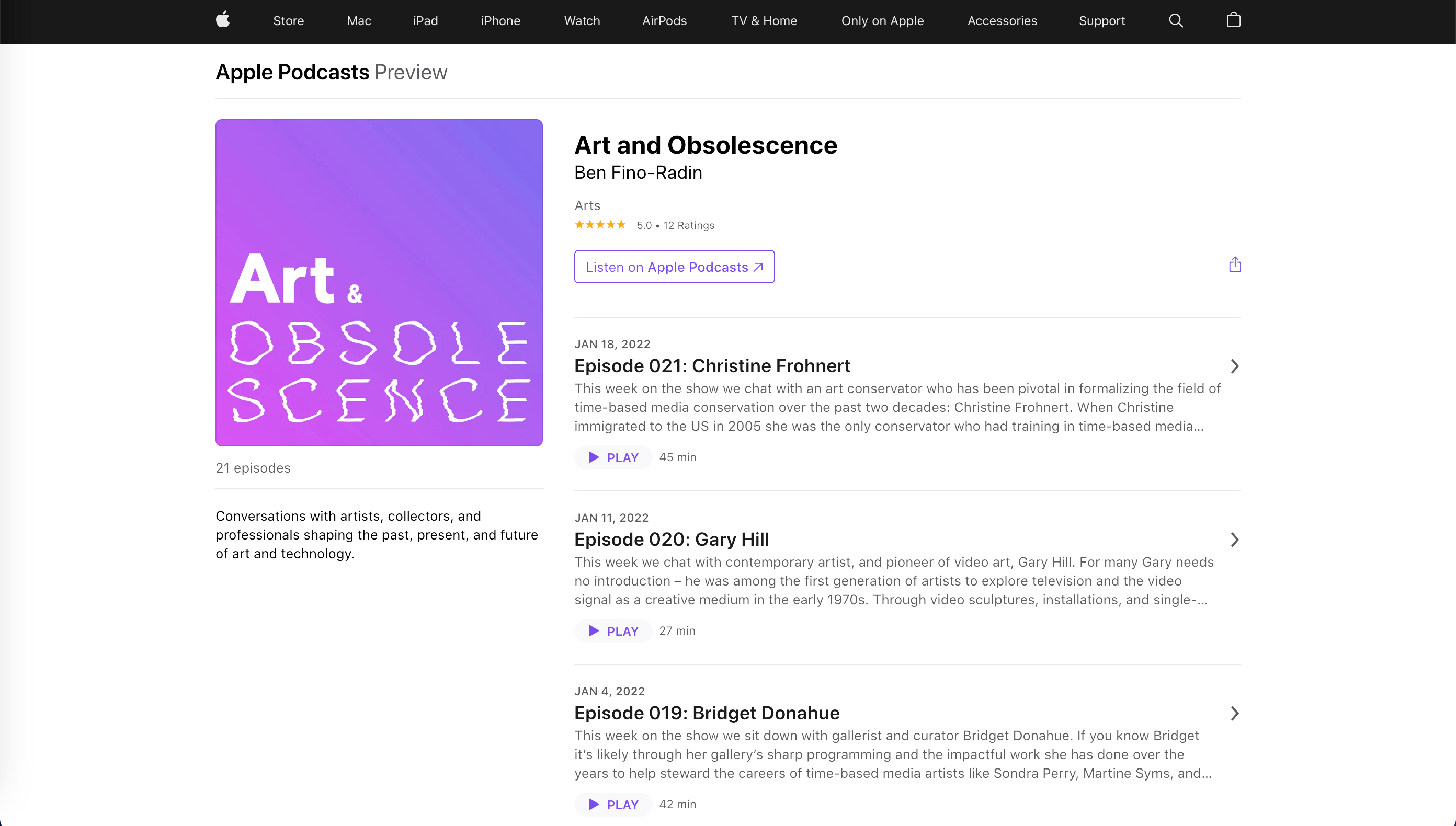
At the same time, Ben is also pursuing other initiatives in parallel in order to make archival expertise more accessible and affordable. One is Archive Academy. This is an online lesson program offered for people who cannot afford to hire a consultant but need to build archives themselves. The other is Ben’s podcast program, Art and Obsolescence, which began in August 2021. It is an oral-history archive project in which Ben interviews artists and art professionals who are shaping the past, present, and future of art and technology. Published interviews include figures such as the artist Gary Hill, known as a pioneer of video art. One can casually enjoy suggestive conversations via podcast with people such as artist Shu Lea Cheang, whom I myself have met, and Barbara London, the curator who pioneered video art exhibitions at MoMA.
Art and Obsolescence has become a kind of medium that helps Small Data form an organic network with artists and related professionals, opening unlimited possibilities for collaboration. The records produced by this medium themselves are becoming a valuable archive, both for Small Data’s business and for future archivists and researchers like Ben. At present it is completely DIY, but he is considering fundraising and bringing collaborators on board for the future.
What Ben imagines for Small Data is a malleable form: something like a flexible container that can deform without being destroyed by small shocks or pressures. He says he wants it to remain fluid at all times.
Project Example: Cooper Hewitt, Smithsonian Design Museum
Cooper Hewitt, which accepted Ben’s proposal, began a large-scale initiative in 2017 for the preservation of digital collections: the Digital Collection Materials Project. Digital objects and digital media can become difficult to access over time and through technological evolution, and information loss may also occur. The project aims to keep both the hardware and software aspects of the collection in good condition and to enable long-term access and future exhibition (33In order to conserve digital art that can only be run on old browsers or operating systems that are no longer supported, old system emulators and independently developed software may be required.).
Of the more than 210,000 design objects in Cooper Hewitt’s collection, approximately 150 are digital works. In addition to home and office electronics, personal computers, mobile devices, media players, and similar objects, the museum has also collected born-digital software applications and moving-image media materials. The diversity of these collections expresses the museum’s belief, stated on the Cooper Hewitt website, that “design is best understood through process.”
Ben and his team carried out a thorough survey to understand exactly how each collection item had been acquired and what its current condition was, and they conducted case studies of carefully selected objects (44The following were selected as case studies: Golan Levin’s Free Universal Construction Kit; IBM’s unreleased prototype Leapfrog; Motorola’s Envoy; en:GRiD Systems Corporation’s GRiD Compass laptop; NeXT Computer’s NeXTcube computer; the iOS application Planetary; and the interactive robotic device Sketchbot.). One of the selected objects, Motorola’s Envoy, occupies a very important position within Cooper Hewitt’s collection, Ben says. Among the portable personal electronic devices in the collection, this model apparently best represents the origins of today’s smartphone. It is also interesting from the standpoint of media archaeology (55Erkki Huhtamo, edited and translated by Junki Ota, Media Archaeology, NTT Publishing, 2015.) as proposed by Erkki Huhtamo. Through the case studies, the team aimed to establish reusable techniques and methodologies for responding to the materials that make up the objects and to similar collections. Ben reflects as follows.
This is important work, and not merely as a means of preserving cultural heritage or design history. The upheavals and revolutions in technology over the past half century have prompted discussion about the impact of digital technologies on society and human life. Without a genuine historical record of what these changes were and how they were implemented in human life, we will not be able to think critically about our future.
To grasp the transitions in the objects and media that people have used from the past to the present, and in their designs, is precisely to trace the history of human beings and human life.
Ben also says that, in the field of cultural heritage preservation, there are two areas of research and practice that can serve as references when thinking about how to collect, manage, and exhibit digital objects.
The first is “digital preservation.” Digital preservation concerns the long-term preservation and protection of digital materials, often materials collected by libraries and archives, such as books, periodicals, web content, and special collections. The second field is “the conservation of time-based media art.” Originating in museums, this concerns the preservation of artworks that use technologies such as film, video, sound recording, and software as artistic materials. Digital preservation and time-based media conservation are highly interdisciplinary, frequently overlapping and borrowing methodologies from one another. Experts in both fields may face the challenge of preserving digital design materials. At MoMA, for example, time-based media conservators are responsible for video games and digital fonts collected by the Department of Architecture and Design.
Small Data’s work with Cooper Hewitt has continued for five years and is still ongoing. For details, I encourage readers to read the project outcomes report on the work Ben carried out with them.
Project Example: The Whitney Museum of American Art
The Whitney, which specializes in American art, has focused on the collection, preservation, and exhibition of American art since its founding. It is also known as the museum that organized a large-scale exhibition of video artist Nam June Paik in 1982. Having accumulated a collection of time-based media art throughout the twentieth century, the Whitney was considering ways to build infrastructure for its protection and conservation, and asked Small Data to carry out the work.
Because the museum needed a comprehensive digital preservation and execution system that would meet the needs of a wide range of stakeholders across many departments, including curators, registrars, conservators, AV technicians, and IT staff, Ben began the project with a highly human-centered approach. He started by interviewing every member of the Whitney’s interdisciplinary team who would have any involvement with the system. Through repeated conversations with staff, he documented all their needs, wishes, and requirements based on those interviews. He formulated a series of functional requirements and supported the museum in finding an achievable and sustainable operating method while taking best practices into account.
Ultimately, based on this information, they built a custom solution by combining two open source software systems, Archivematica and ResourceSpace. I asked Ben why they decided to combine those two.
The makers of Archivematica and ResourceSpace each responded separately to our request for proposals, but we realized that by combining the two, we could meet the Whitney’s requirements better than with any other product. And because they happened to be more affordable than other products, we could combine them within the Whitney’s budget. The two open source systems complement each other extremely well, and I was surprised that no one had integrated them before. This also proved the value of defining needs through a user-driven approach and putting together a full RFP process, that is, a Request for Proposal. If we had skipped that process and simply proposed a solution based on our own rules of thumb, I do not think we would have arrived at the right solution for their problem.
The project with the Whitney began in spring 2018 and was completed about one year later, the following spring. After completion, Small Data created custom workflows, prepared detailed documentation, and provided hands-on training for Whitney staff so that the system could continue to be operated inside the institution. After that process, the system left Small Data’s hands and is now fully managed by the Whitney team.
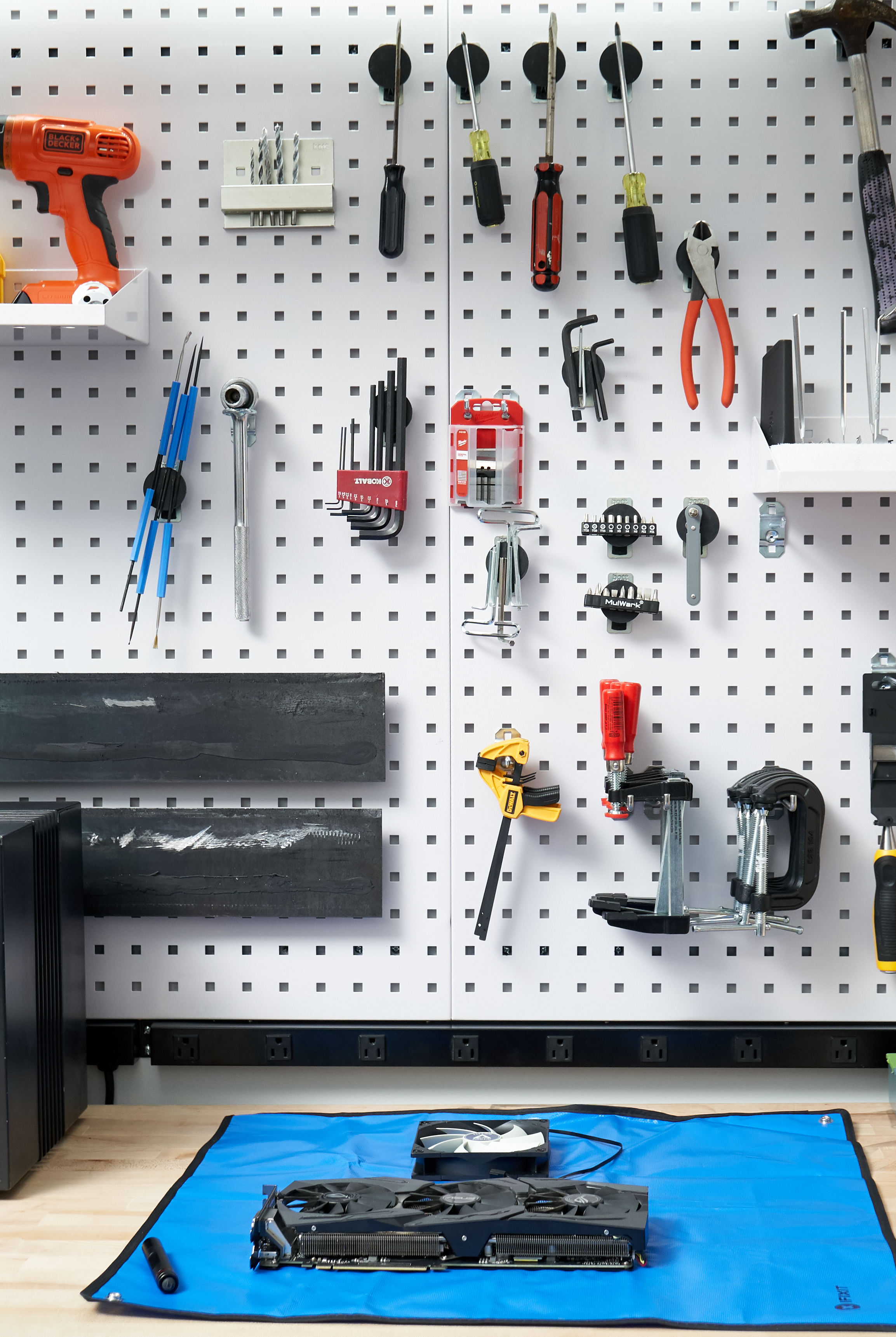
Ben Fino-Radin is the founder and lead conservator of Small Data Industries. Before founding the company in 2017, he led initiatives as Rhizome’s first digital conservator and later served as associate media conservator at the Museum of Modern Art (MoMA) in New York. He graduated from Pratt Institute and holds master’s degrees in library and information science and in digital art. https://smalldata.industries/ https://benfinoradin.info/
URLs were last checked on February 10, 2022.