Critique
FASHION, DISCRETIZED HUMAN AND ITS MODALITY
#4
Fashion, Religion, and Virus
The original text was written in Japanese and published in EKRITS.JP on October 20, 2016. This post is translated from the 4th section of the original article.
FASHION, RELIGION, AND VIRUS
Cristóbal Balenciaga, the successful fashion designer of the 20th century left the following words.
“A couturier must be an architect for design, a sculptor for shape, a painter for color, a musician for harmony, and a philosopher for temperance.”
Within the century of his appearance, it is said that the manner of clothing based on the human body has ran out. Various styles were born, institutionalized as a uniform, and have been immobilized as the next new category, such as Punk, Trad, Work, Street, Avantgarde, and etc.
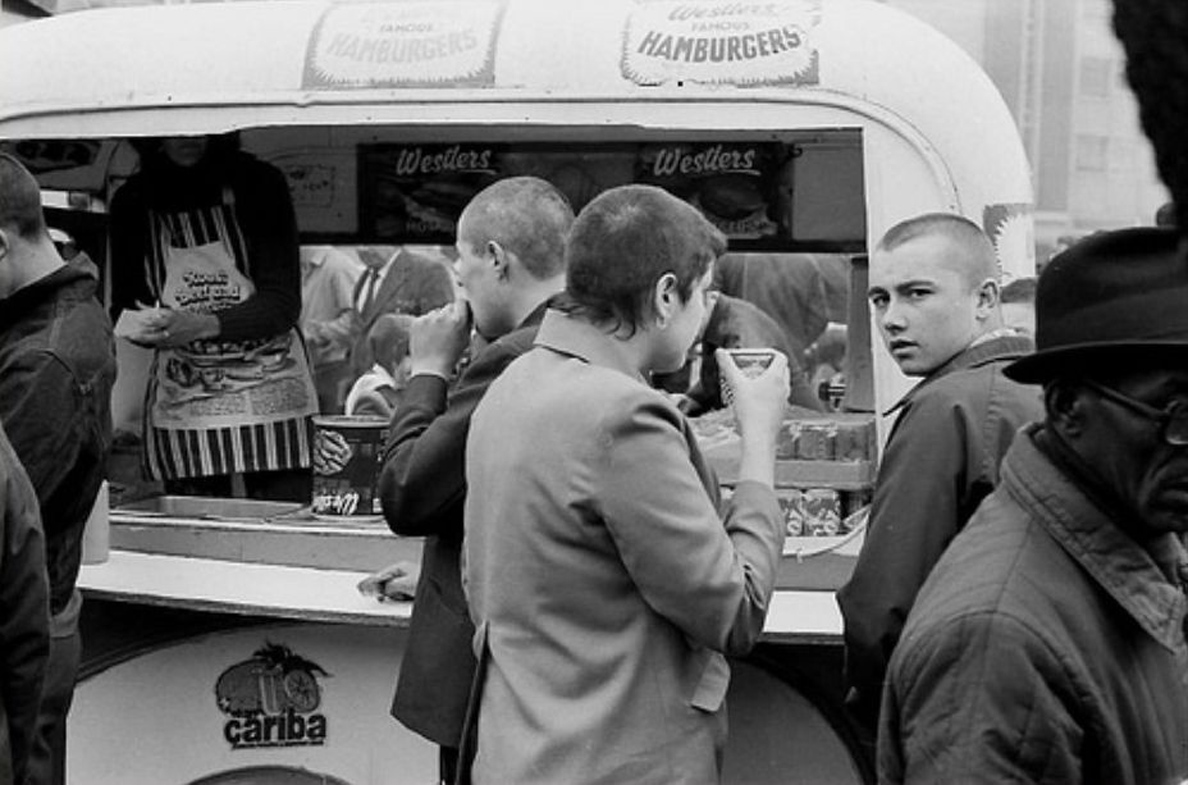
Photo of London in the 80’s. An educated computer program could easily profile the social class or attributes of these photo subjects. Likewise, we are unconsciously determining the attributes of the other.
“Skinheads in London City in 1981” (1981), via Wikimedia Commons
Most of today’s creation, except for a slight difference in the detail and texture, are inevitably retrieved in the existing categories. This circumstance can be seen explicitly in the way magazines and media, boutiques, department stores, online stores categorize merchandise.
To simplify this point of view, consider a plane coordinate system, where the immobilized existing categories are placed on the X-axis, and the merchandise and retail prices are placed on the Y-axis. The act of designing can be considered as creating an item that can be plotted on this plane, and to plot and land in an unknown realm is considered to be what we know as creating a new style.We could see the population per community by plotting z-axis on the plane. The plane could look like a map of bacteria cultured on a medium or some heat maps.
The turning point of fashion in a cultural context was marked whenever a new type of style was disseminated. The new fashion has hacked the unspoken codes and traditional values and obscured the boundaries of the community. And by evoking sympathy, fashion has changed the status quo. A new style turns into a uniform of these people who comes and goes along the blurred boundaries. The image of this style spreads amongst the people and affects the mind of the other along with the words associated with this image.
Tadao Umesao Tadao Umesao / 梅貞忠夫 (1920 – 2010) : Cultural Anthropologist. His main work “Introduction to an ecological view of civilization” contains various suggestive topics that are also relevant to fashion., a Japanese cultural anthropologist, once advocated the virus theory of religion. But if we consider the viral aspect of fashion, we can see that fashion is a social phenomenon that has religious characteristics. In this sense, Judaism, Islam, Christians, Buddhism has always been influencing the human dynamics; this can be considered as the “designing in-distance” at the ultimate degree.
MATHEMATICAL DESCRIPTION FOR A STRUCTURAL VIEW OF DESIGNING IN-DISTANCE
Let us formulate the previous argument more explicitly. The point is not that design is merely an object placed inside the world. Design should be understood as an operation upon the state of the world. It introduces a new system, modifies the relation between human agents and existing systems, and thereby changes the trajectory of possible futures.
Consider a given historical interval \(t\). Let \(\mathcal{H}(t)\) be the set of human agents existing within that interval. Let \(\mathfrak{S}(t)\) be the set of systems, institutions, objects, codes, and media that coexist with them. We write
for their respective cardinalities.1 1The vertical bars \(|\cdot|\) indicate cardinality, that is, the number of elements in a set. Thus \(N(t)\) is the number of human agents, and \(M(t)\) is the number of systems or objects considered within the interval \(t\). These numbers should not be confused with the dimension of the state-space.
The notation is chosen as follows. The letter \(H\) is used for human agents. The Gothic letter \(\mathfrak{S}\) is used for the set of systems in order to distinguish the set of systems from the state of an individual system, which will be denoted by \(S_j(t)\). The letter \(S\) is used because the relevant objects in this chapter are not only physical things, but systems: garments, rituals, religions, viruses, institutions, codes, platforms, and other structures that can act upon human life. 2 2The distinction between \(\mathfrak{S}(t)\) and \(S_j(t)\) is purely notational but important. \(\mathfrak{S}(t)\) is the set of systems. \(S_j(t)\) is the condition or state of the \(j\)-th system at time \(t\).
1. Human conditions and system conditions
For each human agent \(h_i\in\mathcal{H}(t)\), let
denote the condition of that agent at time \(t\). Here \(C\) stands for condition. The condition \(C_i(t)\) may include bodily state, memory, habit, taste, social position, belief, economic condition, and symbolic orientation.
For each system \(s_j\in\mathfrak{S}(t)\), let
denote the condition of that system at time \(t\). Here \(S\) stands for system. A system may refer not only to a material object, such as a garment, image, shop, magazine, or platform, but also to an immaterial structure, such as a category, rule, institution, religion, language, ritual, virus, or protocol.
More precisely, the condition space of a human agent need not be purely numerical. One may write
where \(\mathbb{R}^{p_i}\) denotes the continuous or measurable part of the agent’s condition, and \(\mathcal{K}_i\) denotes its discrete, symbolic, or categorical part. Likewise, one may write
where \(\mathbb{R}^{q_j}\) describes measurable or continuous features of the system, and \(\mathcal{L}_j\) describes symbolic, institutional, technical, or categorical features.3 3For example, age, income, body temperature, geographical position, or intensity of preference may be treated as continuous variables. By contrast, language, social category, religious affiliation, ritual role, institutional position, or symbolic code may be treated as discrete or categorical variables. The model is therefore hybrid: part continuous, part discrete, part symbolic.
We may collect the human conditions and system conditions into product spaces:
If all continuous components are finite-dimensional, then the continuous part of these product spaces is contained in a real vector space of dimension
This \(P(t)\) is a dimension. It is not the same thing as \(N(t)\), \(M(t)\), or \(N(t)\times M(t)\). 4 4\(N(t)\) and \(M(t)\) are cardinalities: they count humans and systems. \(P(t)\) is the dimension of the continuous part of the state-space. By contrast, \(N(t)\times M(t)\) counts the number of possible human-system pairs. It naturally appears when one describes the interaction structure between humans and systems.
2. The relation structure
The world is not a mere collection of human agents and systems. Human beings and systems are related to one another. A garment is worn, desired, refused, copied, remembered, or institutionalised. A religion is believed, practised, transmitted, prohibited, or ritualised. A virus infects, circulates, modifies behaviour, and reorganises institutions. These relations are part of the structure of the world.
We therefore introduce a relation matrix
Here \(R\) stands for relation. The entry \(r_{ij}(t)\) denotes the relation between human agent \(h_i\) and system \(s_j\) at time \(t\). This relation may include use, belief, infection, desire, rejection, imitation, memory, discipline, dependence, or symbolic recognition.5 5The matrix notation does not imply that every relation is already numerical. It only indicates that there may be a structured relation between each human agent and each system. Some entries may be numerical, some categorical, some symbolic, and some empty or undefined.
The state of the world at time \(t\) may then be represented as a relational object:
The letter \(A\) is used here for the aggregate state of the world. Strictly speaking, \(A(t)\) is not merely a vector. It is a structured state consisting of human conditions, system conditions, and the relation structure between them. In this sense, the world is not a list of objects but a relational state-space.6 6If one ignores the relation matrix \(R(t)\), the state-space may look like a simple product space. But for fashion, religion, and virus, the relation structure is essential. A garment, a ritual, or a virus becomes historically significant only through the relations it forms with human bodies, institutions, and symbolic systems.
3. Mutual updating
The condition of a human agent is not isolated. It is updated through its relation to other human agents and to the systems that surround it. We may therefore write
Here \(F_i\) is the component map that updates the condition of human agent \(i\). The letter \(F\) is used because the map describes how a human condition is formed or transformed by the whole relational state \(A(t)\).
Likewise, the condition of a system is also updated by human agents and by other systems. We may write
Here \(G_j\) is the component map that updates the condition of system \(j\). The letter \(G\) is used simply to distinguish the system-side update from the human-side update \(F_i\). In addition, the relation matrix itself may change:
Here \(H\) denotes the update of the relation structure. Taken together, these component maps define an update operator:
This formulation allows fashion, religion, and virus to be described through a common structural logic. Each of them changes human conditions, system conditions, and the relations between them. None of them is merely an object inside the world. Each participates in the updating of the world-state. 7 7No linearity is assumed. The maps \(F_i\), \(G_j\), and \(H\) may be nonlinear, discontinuous, historical, symbolic, institutional, or path-dependent. A small sign, ritual, image, garment, or infection may have a disproportionate effect.
4. Design as operation
We can now describe an act of design. A design is not only a new object. It is an operation upon the world-state. Let
denote a design operation at time \(t\). The letter \(O\) is used for operation. The subscript \(x\) indicates that this operation introduces a specific new system \(S_x\) into the world. Thus \(O_x(t)\) should be distinguished from \(S_x\). \(O_x(t)\) is the act or operation of design. \(S_x\) is the new system, object, code, ritual, garment, or institution introduced by that operation. 8 8This distinction avoids a common ambiguity. A designed garment, image, or institution may be denoted by \(S_x\), because it becomes a system or system-like object within the world. The design act that introduces it is denoted by \(O_x(t)\), because it operates upon the world-state.
The operation may be written schematically as
The symbol \(\oplus\) does not mean ordinary addition. It means that a new system is introduced into the relational state of the world. Once \(S_x\) is introduced, the relation matrix \(R(t)\) may also change, because the new system can form new relations with human agents and existing systems. 9 9The notation \(A(t)\oplus S_x\) is not meant as a literal algebraic sum. It indicates that a new system is inserted into the world-state and may alter the existing structure of relations. In many cases, this operation changes not only \(\mathcal{S}(t)\), but also \(R(t)\), and eventually \(\mathcal{C}(t)\).
5. Designing in-distance
Let \(\Phi_\tau\) be the transition map that carries a present world-state into a future world-state over the time horizon \(\tau>0\). The Greek letter \(\Phi\) is used here because it conventionally denotes a transformation or flow. The subscript \(\tau\) indicates the length of the temporal distance.
Without the design operation, the future state may be written as
With the design operation \(O_x(t)\), the future state may be written as
The superscript \((0)\) denotes the baseline trajectory, in which the new system is not introduced. The superscript \((x)\) denotes the trajectory affected by the operation \(O_x(t)\) and the introduced system \(S_x\). The effect of design is therefore not measured only by immediate acceptance, use, purchase, or recognition. It is measured by the distance between two possible futures:
Here \(D_x(\tau)\) denotes the future difference produced by the design operation \(O_x(t)\), and \(d\) denotes a chosen measure of difference between possible world-states.10 10The distance \(d\) does not need to be a physical or Euclidean distance. It may be a social, symbolic, institutional, historical, cultural, or computational measure of difference. The point is that the value of a design can be discussed in relation to the trajectory it creates, not only the object it immediately appears to be.
When the time horizon \(\tau\) is small, this formulation describes ordinary design effects: a change in use, perception, taste, purchase, imitation, or social behaviour. But when \(\tau\) approaches a historical, civilisational, or nearly eternal distance, the question becomes more radical. It is no longer whether the designed object is consumed, worn, recognised, or circulated in the present. The question is whether the design operation \(O_x(t)\), through the system \(S_x\) that it introduces, can alter the long-term trajectory of the world-state itself.
In this sense, fashion, religion, and virus may be understood through a common structural logic. Each is not merely an object within the world. Each is capable of operating upon the relation between human agents, systems, institutions, bodies, and future states of the world. “Designing in-distance” therefore names the act of creating an operation whose consequences exceed the immediate scale of its appearance.