Interview
FREE MAGAZINE ISSUE#3 “NEW MIND NEW LOOK” | The Present as Narrative: Interview with Ben Lerner
Originally published by FREE MAGAZINE ISSUE#3 “New Mind New Look”. Interview text by Yusuke Koishi.

The Present as Narrative
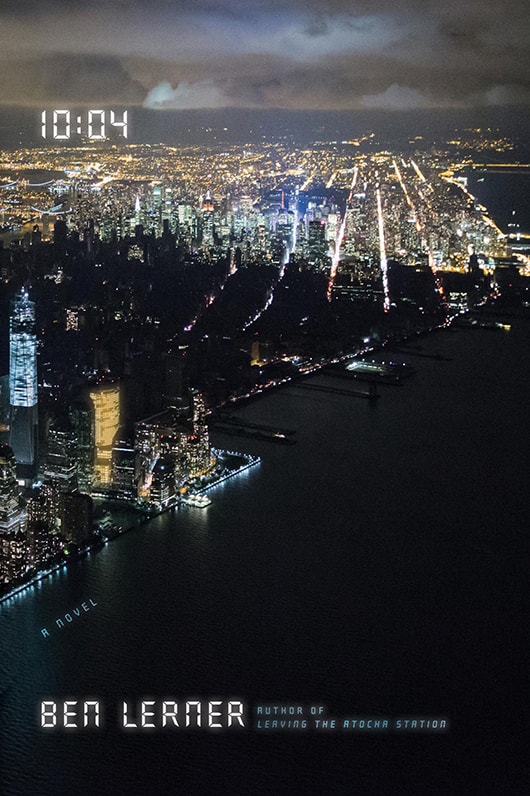
Last October, I had the chance to spend about three weeks in New York. Just as I was finally growing accustomed to that restless city, and had acquired enough room in myself to walk through the streets downtown while thinking, I suddenly wanted to read a novel. The book I happened to pick up in a bookstore was Ben Lerner’s 10:04 (Picador USA, 2014). As I looked over a stack of books beneath a sign that said “LITERATURE,” the title written in those numbers caught my eye. Since we have become able to listen to music without buying CDs, perhaps books and clothes are now among the few pleasures left that one still buys by instinct, on the spot. Thinking this, I turned to the opening page, and there was New York, in the present tense.
New York is said to be the most competitive city in the world, in every field. Writers are no exception. Just as Paris exists as the central stage of presentation for fashion, New York has played an enormous role in modern and contemporary literature. Across its history, the city has produced a long line of major writers: Herman Melville of Moby-Dick, Truman Capote of Breakfast at Tiffany’s, F. Scott Fitzgerald of The Great Gatsby, J. D. Salinger of The Catcher in the Rye, Kurt Vonnegut of Slaughterhouse-Five, and Irwin Shaw, master of the short story. If we include living writers, names such as John Updike, Philip Roth, and Paul Auster appear, all writers of global stature. Their works continue to exert an invisible influence, like gravity, even on people who have never read the books themselves. And the fiction section of The New Yorker, published by Condé Nast since 1925, remains a kind of gateway through which a writer becomes known across the English-speaking world. Many people subscribe to the magazine for that section alone. It is also said that one of the reasons Haruki Murakami became internationally known was that his short fiction appeared there.
Ben Lerner was born in 1979 in Topeka, Kansas, a Midwestern American city of about 120,000 people. After university, he began his career as a poet. While still in his twenties, he published three poetry collections and won several prizes in the United States and abroad. In 2011, he published his first novel, Leaving the Atocha Station. In 2012 he published a short story in the aforementioned The New Yorker. Beyond fiction, he is also highly regarded for his criticism and essays on art and literature, and has emerged as one of the most promising young American writers. In 2014, he published a novel that contained a new kind of experiment. That novel was 10:04.
What is interesting about 10:04 is how divided the response has been. On one side are immense words of praise, such as the claim in The New York Review of Books that “if he never writes another book, this one will last.” On the other are interviews written from an undecided position, unable to determine whether the book is good or bad, and severe reviews by avid readers saying that nothing happens until the end, that the characters are dull, or that the story is absent. It is true that Lerner’s work contains no intricately engineered plot, and almost no dramatic incident. It seems, at first glance, to consist simply of scenes in which a young writer, much like Lerner himself, lives in the metropolis of New York, and of monologues describing the events of reality in front of him.
Reading these divided responses, I remembered one of the important disputes in literary history: the exchange between Ryunosuke Akutagawa and Junichiro Tanizaki. Akutagawa argued that the interest of a plot does not strengthen the artistic value of the work itself, while Tanizaki replied that to exclude the interest of plot is to abandon the privilege belonging to the form of the novel. The debate ended without resolution after Akutagawa’s suicide, but more than eighty years later, Lerner’s new attempt seemed to make it return, across borders and across time. This time, not in the hands of two writers, but in the hands of ordinary readers.
Historically, literature has often taken “the friction between the self and society” as its subject: the conflict of the mind when one truly thinks something but cannot behave accordingly; the dissonance that arises between an individual and society; the doubt one directs toward oneself. In each age, while many contemporary people struggle with their own identities, works that shake the ego and describe the movement of the mind with precision have gathered sympathy. Some works weave conceptual thought into narrative. Others skillfully use stimulants such as sex, drugs, death, poverty, and violence to build an extraordinary world.
Lerner’s newness lies in the way he shows, once again, the possibility that by continuing to describe the reality before one’s eyes, a narrative naturally begins to appear. The protagonist, a writer, is simply drawn into the everyday life of New York. The casual atmosphere of the city, the appearance of people, the events of daily life, and the movements of the mind reacting to them are written as if improvised. No artificial “novelistic incident” occurs there. Yet the events written with rhythm certainly contain a rich narrativity.
Hideo Kobayashi is said to have argued that, when facing the classics, one must not bring in the concepts of the present. To understand the heart of ancient people’s words, one must imagine the world in which those people lived down to its smallest corners, and synchronize oneself with their sensibility. If that cannot be done, then one cannot possibly see the scenery ancient people actually saw.
Then what should we do when we look not at antiquity, but at the present? I felt that Lerner’s writing offered a hint. Through the medium of his narrative, we can learn that the reality spread out before us contains a fertile world beyond the divisions of fiction and nonfiction. Without noticing it, we live by curating reality through our own sensibilities. How we perceive and choose the reality before us, and whether we feel a story there, is entirely entrusted to us.
Koishi: Where do you live now? In Brooklyn?
Ben Lerner: Brooklyn
Koishi: When did you start living in NYC? Do you like the city? If so, why?
Ben Lerner: I moved here five years ago but have lived here before. Yes, I love it, despite how much of it has been ruined by finance. It’s where the cultural energies I care most about are most alive
Koishi: What is your favorite place in NYC?
Ben Lerner: I guess the Brooklyn Bridge, crossing it
Koishi: How do you start your work every day?
Ben Lerner: These days my young kids are in charge. There is no predictability
Koishi: When did you realize you wanted to be a poet or writer? What was the clue?
Ben Lerner: I’m still not sure I want to be a poet or a writer.
Koishi: Do you have friends who are novelists or poets?
Ben Lerner: Of course. I have many more friends who are poets than novelists, since that’s the center for me–that’s where my community is.
Koishi: Do you ever visit fashion stores? If you have a favorite brand, what is it?
Ben Lerner: No
Koishi: What kind of books do you read? If you have a favorite novelist or author, please let me know.
Ben Lerner: I read all kinds of books.
About 10:04, Writing, and Life in NYC
Koishi: Unlike the following comment from the agent who appears in 10:04, the protagonist begins writing poetry in Marfa. The novel 10:04 itself has multiple structures, and there are more prose textures than fiction-like dramatic transformation. What were you thinking about when you were writing this novel?
“Just remember this is your opportunity to reach a much wider audience. You have to decide who you want your audience to be, who you think it is. … Develop a clear, geometrical plot; describe faces, even those at the next table; make sure the protagonist undergoes a dramatic transformation.”
Ben Lerner: This book wants to remember the basic miracle of text–that it’s a technology of time travel. That it allows one to address a “you” in the present tense of reading, whenever that reading takes place. It’s less that I can or could imagine the specific reader than I wanted to open up that Whitmanic channel of communication across temporalities. The problem with the agent’s suggestion is that it wants to imagine audience only quantitatively and not qualitatively and it wants to surrender the particularity of the artwork into crowd sourcing.
Koishi: The argument around “story, plot, or texture” was actually discussed in Japan in the 1910s, between Akutagawa, on the side of texture, and Tanizaki, on the side of plot. I found many praises and criticisms of your new book, and some controversial comments on the internet. These reactions reminded me of that argument in Japanese literature. Personally, I think the current trend in Japanese literature focuses too much on plot structure. I really like your writing.
Ben Lerner: That’s very interesting.
Koishi: During my reading, the narrator’s voice sometimes reminded me of Notes from Underground. Do your works, including Leaving the Atocha Station, partly include homages to previous literary works?
Ben Lerner: I definitely like the antihero–the hero who arrives at truth through ruthless self-denunciation. I think this was more true of the first novel, but yes, Notes from the underground was an important book for me. Literature is always made out of arguments with previous works, I think.
Koishi: Back to the Future was quoted often, including in the title. Please tell us more about the relationship between this story and Back to the Future.
Ben Lerner: Well, Back to the Future is a story of time travel and paternity and artistic reinvention. There are great things about it and terrible things about it, but my book is in many ways concerned with similar dramas–how our changing notion of the past shifts the present and the future, for instance. And my book also involves a lot of stories about familial history and the fictions it involves. 10:04 is both the moment in the movie where Marty travels back to the future and the minute 10:04 in Christian Marclay’s incredible video collage, entiled “The Clock.” So I’m both citing Back to the Future and its recycling. The 1980s are also crucial in my book in a variety of ways — it’s the narrator’s childhood and a moment of triumphant American empire.
Koishi: What time would you want to travel to if a DeLorean were available now?
Ben Lerner: I have no idea.
Koishi: The name “Walt Whitman” appears frequently in the book. What does his existence mean to this book? Is there a stream of American poetry potentially underlying the book?
Ben Lerner: I think the book explains Whitman’s relevance and significance better than I can.
Koishi: Scenes around art appear frequently in your book, and also in your previous novel, Leaving the Atocha Station: Christian Marclay’s The Clock, a broken Jeff Koons sculpture, and Donald Judd. Alena is also an artist who lives in NYC, the most competitive city in the world. You seem to have many connections with artists. What does art do in your life and your work?
Ben Lerner: I’m really interested in the novel as a curatorial form–how can the novel absorb other kinds of artworks, how can it offer really robust descriptions of artistic encounters, and so on. The novel is an art work that can capture our experience of other artworks — I think of Proust’s descriptions of music, for example. I love Proust’s descriptions of music than the music he describes. Art is also important in this book because the art world in New York is a circus where capitalism in its most decadent form collides and recombines or colludes with art. I’m interested in the contradictions between the claims made for art and its role in the market from which art so often claims to separate itself.
Koishi: NYC is the most iconic physical form of capitalism: Wall Street, expensive rent and food, art, culture, poverty, danger, and many things that imply an uncertain tomorrow. In the city of the present period, the phrase “truth is stranger than fiction” might sound realistic, but your story might also imply that truth itself is becoming very fictional in some aspects. Tragic fact or seriousness appears like comedy, and vice versa, apropos of nothing. While reading your book, I thought it is becoming difficult to capture where we are, even with our usual preconceptions. Or maybe a new kind of perceptive sense is being born in this period. Please let us know what you are thinking about your life in NYC, and generally.
Ben Lerner: New York is a site of horrible financial excess and standardization but it’s also a place where real culture and energy seeps out through the cracks in that system.
Koishi: As mentioned above, the nonfictional reality in which we live is becoming very fictional in some ways. What do you think about the role of storytelling, writing, and poetry in this period? Do you think it has changed compared with twenty or thirty years ago, or with one hundred years ago?
Ben Lerner: Story-telling is the way humans make sense of time — how we organize chaos into a structure of significance. I think what a lot of writers are focused on now (no matter their genre) is to think through the current possibilities of narrative organization and reorganization beyond the “fiction / nonfiction” divide.
Koishi: What is “newness” to you? What makes you feel that something is new?
Ben Lerner: One thing that is very old is the imperative to be new and I think it’s newer, fresher, to avoid making a fetish of novelty.
SPECIAL THANKS TO DECLAN TAINTOR (PICADOR USA).