Magazine
Essay Series “Walking Now” MISHIMAGAZINE #11 – The “Make America Great Again” Hat as a Fashion Item
The original text was written in Japanese for MISHIMAGAZINE and published on June 20, 2018. This post is an English translation and republication of the original article.
There is a baseball cap embroidered with the message “MAKE AMERICA GREAT AGAIN.” Commonly known as the MAGA HAT, it was used in Donald Trump’s presidential campaign, and recently this cap became a topic of conversation once again.
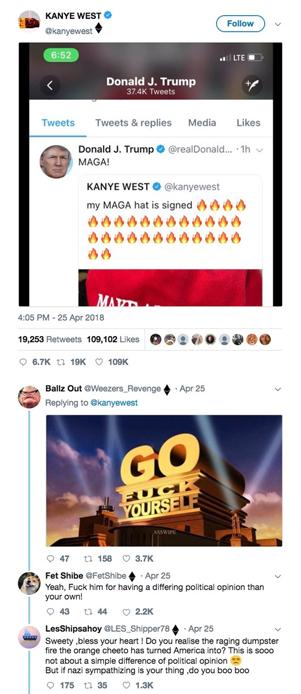
Kanye West, the musician and multitalent who now also runs his own fashion brand YEEZY, posted a MAGA HAT signed by Donald Trump on Instagram and Twitter on April 26, together with a message of support for President Trump. Naturally, about ninety percent of the comments that appeared in the news and on social media were critical of him. Not only fans who had followed Kanye West, but even friends of his declared on Instagram and Twitter that they would unfollow his accounts and condemned him strongly. Had he not possessed the commercial influence of someone like Kanye West, the criticism would probably have swallowed him whole. In fact, after this post, another fire broke out around a later interview in which he made the problematic remark that “slavery was a choice.” This poured oil on the flames. Still, the main cause of that particular uproar seems to have been not only Kanye West’s risky phrasing, but also the fact that the remarks were cut out of their surrounding context and circulated that way.
1 The TMZ Live interview that triggered the controversy.
2 A Japanese translation of much of the same interview was circulated as reference material: note.mu/raplyric.
Looking back through history, perhaps there has never been an age in which a single sentence could wield more power than it does now. The simple sentence “MAKE AMERICA GREAT AGAIN” came to mean far more than “make America great again” once it was taken up by Donald Trump, a symbolic political icon. It became not only a slogan in its literal sense, but a message symbolizing communities divided by a presidential election. Trump did not create that meaning by himself. It arose from the relationship between the people who received the phrase and the environment in which it circulated. Words do not possess meaning by themselves.
Recently, a stylist I know took the situation with a certain irony and walked around wearing a pink MAGA HAT. At this point, the MAGA HAT has become a fashion item that sends an extreme message. So what exactly does it symbolize? Is there now anyone, except a rare specimen, who would read it simply as the image of “I am a patriot”? Of course, it probably still means “I support Donald Trump,” or at least his policies. But in Kanye West’s context, it seemed to say something closer to: “I am not afraid of criticism, and I do not care what other people think of me.” For an ordinary person to wear this hat in New York or Boston today must be a fairly punk act. If someone wore it in a Brooklyn cafe, I imagine they would be met with a cold shoulder. Yet if one asked whether every New Yorker is critical of the phrase “MAKE AMERICA GREAT AGAIN” itself, what sort of answer would come back? The comparison is imperfect, but in the sense that it can no longer be worn openly, the MAGA HAT may have become something like the cross once carried by hidden Christians in this country centuries ago.
Speaking of fires started by words, some may remember a similar case in Japan. When Hiroshi Sugimoto, the photographer and contemporary artist based in New York, was selected as a Person of Cultural Merit in 2017, he released a comment saying that, as a Person of Cultural Merit, he would continue to contribute to the “enhancement of national prestige” through culture. The phrase “enhancement of national prestige” provoked an almost physiological reaction from cultural figures in Japan, who criticized it all at once. But on closer inspection, the phrase itself is not simple. Its difficulty lies in its historical background, especially in how it has been used in the past. If one mechanically reads the kanji as “raising the prestige of the nation externally,” it does not necessarily carry an especially strong meaning. What intellectuals and newspapers found repulsive, of course, was its connection to prewar and wartime nationalism. Yet the scene reminded us that words exceed their linguistic definitions through the behavior of the people and communities that have used them. What was strange about this uproar was that almost no one discussed Sugimoto as an artist, or why a person like Sugimoto, who had long worked in the United States, would make such a statement. Sugimoto himself was absent from the discussion. What remained were the sign attached to “enhancement of national prestige” and the signified figure of “an internationally active Japanese artist.”
Kanye West, too, seems to have become a symbolic sign through this incident. The uproar over his remarks about slavery, mentioned above, arose because he had already been marked as a Trump supporter, and those critical of Trump supporters cut out his words without their surrounding context and circulated them, half deliberately, on social media. Watching this, I felt that today one’s attitude toward society, and the record of that attitude, have also become part of fashion. Perhaps this has been true for some time. From antiquity to the present, people have been judged by appearance, by class, by affiliation. But now the object of “our” attention, and the relationship between “us” and that object, are themselves published on social media. And they have become factors as important as the human exterior. We wear the accumulated statements and data of social media around our bodies.
In the interview that caught fire, Kanye West, who has long seen himself as representing the Black community, says that he wants to represent not only Black people but human beings. Watching the sequence of events, I felt confronted by the question of whether the possibility of a strong and neutral existence has ever existed in human history. Whether we like it or not, we are sorted.
To take even a single position is, in truth, difficult in our age. It clings to us like clothing and governs our context. Will Kanye West wearing a MAGA HAT become the same kind of sign as the MAGA HAT itself? The MAGA HAT, and Kanye West himself, will probably continue to exist as fashion items emitting a powerful message until both those who accept them and those who despise them have gone away, and no one cares anymore.