Magazine
Essay Series “Walking Now” MISHIMAGAZINE #12 – Fashion as Knowledge: On the Figure of ALIE WEAVER
The original text was written in Japanese for MISHIMAGAZINE and published on September 11, 2018. This post is an English translation and republication of the original article.
At the end of June, we held an exhibition in Jingumae, Tokyo, titled BEING AND TIME. The participants were three parties: the photographer Daisuke Hamada, the Swedish-born photographer Jorgen Axelvall, and KLEINSTEIN, meaning Yusuke Koishi and Miki Koishi. Because the sponsoring organization wanted the exhibition to touch on life and death, we decided to frame the show more abstractly as a space for thinking about existence and time.
The exhibition was confirmed about six weeks before it opened. We shared only a simple theme and almost no details, but strange things happen when a basic sense of direction is shared. Without ever holding a meeting among the three participating groups, we arrived at installation day, and the space came together almost exactly as I had imagined it curatorially.
Jorgen produced and exhibited two photographs titled HERO and HEROIN. HERO depicted a stone statue of Alexander III, Alexander the Great, which he had photographed at the Uffizi Gallery. HEROIN, by contrast, showed a dying heroin-addicted friend from his time in New York. The statue of Alexander the Great at the Uffizi is the image of a young man who left the world at the age of thirty-two while still overflowing with vitality, although the historical basis for whether the statue truly represents Alexander himself is uncertain. By contrast, the existence of the person in New York, who certainly did exist, was at once real and faint. That tension was Jorgen’s reading of the exhibition title. Daisuke Hamada photographed quiet images of the shadows of existence in everyday life: the ordinary moments we usually pass by, where the shadows of life and death reside almost without announcing themselves. His works were vivid yet delicate, and the choice of wooden frame details was very much his own.
What we produced was a series titled NON-TRIVIALS: twelve T-shirts and two drawings. On the back of each T-shirt, a name and number were printed, then framed.
BARTHES 80
DERRIDA 4
EINSTEIN 55
FOUCAULT 84
GROTHENDIECK 14
HEISENBERG 76
MARX 83
NIETZSCHE 0
SONTAG 4
TURING 54
WEAVER 99
WITTGENSTEIN 51
The names in this list are people who are frequently quoted and discussed today. If one sees EINSTEIN, DERRIDA, or FOUCAULT, many people will probably assume that the names refer to Albert Einstein, Jacques Derrida, and Michel Foucault. But how many people in the world could identify every name on the list?
Since ancient times, human beings have placed great importance on knowing something. In very old societies, books were valuable, and except for a small number of people, much information was transmitted orally. The ability to remember and recite that information was proof of intelligence. In Jewish and Islamic communities, the recitation of the Bible or the Quran has long been an act that commands respect. The same was true in Japan.
One figure praised for exceptional memory is Hieda no Are, who was involved in the compilation of the Kojiki. The preface to the Kojiki records the following:
At that time there was a court attendant. His surname was Hieda, his name Are, and he was twenty-eight years old. He was intelligent by nature: what passed before his eyes he could recite aloud, and what brushed his ears he fixed in his heart. The Emperor therefore ordered Are to recite and memorize the imperial genealogy and the ancient words of former ages.
The passage is quoted from the Japanese Wikipedia entry on Hieda no Are.
This was roughly 1,400 years ago, when people who could read and write were still a minority. It is not difficult to imagine that literacy was limited to privileged classes, and that reading and writing themselves were considered intellectual acts. Yet the ability to memorize large bodies of information was a further level above that, a power that drew admiration. To have knowledge, and to be able to accumulate it, was one kind of fashion.
Today, books exist as a matter of course, and access to vast quantities of information has become possible. Creating new knowledge is considered noble, but perhaps because it is difficult, simply knowing things still functions as a general proof of intelligence, or of being an intellectual. Because the methods by which we can know things have diversified, I sometimes feel that not knowing what one ought to know has come to be treated more severely as intellectual negligence. In the past, people who seemed to belong to the world of criticism argued this and that among themselves, sometimes attacking one another’s lack of insight. Recently, however, it has become a familiar spectacle for an intellectual to be criticized by ordinary people on Twitter for a small gap in knowledge, and sometimes to catch fire. Watching these exchanges of flaming comments, I do not know why, but I find myself remembering The Towering Inferno, the 1974 film starring Paul Newman.
To return to the exhibition, among the twelve figures in NON-TRIVIALS, there is actually one person who does not exist: WEAVER. The person we named ALIE WEAVER is a figure we created. Yet when that name is placed alongside giants such as DERRIDA, EINSTEIN, and WITTGENSTEIN, people begin to feel that this person must belong to that category. That illusion was precisely the intention of the work.
When there is something we do not know today, the first tool we use is probably Google Search. In China, where Google is blocked, Baidu is the common search service, though there are certainly people who use a VPN and search with Google anyway.
Many guests came to the reception, and several people, when they found a name they did not recognize, immediately searched for it on Google. Those who had the habit of looking up what they did not know seem to have noticed quickly that ALIE WEAVER was not a real person. In contemporary society, if something does not appear in an internet search, it is almost the same as not existing. Paradoxically, it is also true that in the world we inhabit, if no one searches for a fictional being on the internet, that being can continue to live. ALIE WEAVER, placed among deceased giants of knowledge such as EINSTEIN, TURING, DERRIDA, and GROTHENDIECK, will live forever as a great figure for those who never looked the name up.
The reason the work took the form of T-shirts was also a sarcastic play on the Japanese phrase “to borrow the authority of the tiger.” Looking back through history, in every age and place, speaking by borrowing the authority of dead great figures has been a long fashion trend in human history, and it still seems far from over.
Even today, plausible words decorated with proper names overflow everywhere in the world and spread without being digested. It would be absurd to deny intelligence backed by knowledge, but we human beings, then and now, continue to live in the interval of a rather suspicious world.
Daisuke Hamada
http://www.daisukehamada.com/
Jorgen Axelvall
http://www.jorgenaxelvall.com/
KLEINSTEIN
http://kleinstein.com/
All photos by Jorgen Axelvall.

Exhibition: BEING AND TIME
June 25 – July 1, 2018
Sponsored by The Japan Memento Mori Association

(Left)
Hero / Alexander / Polaroid I20 (2018)
Archival pigment print / dry mount
72.9 x 91.3 cm
(Right)
Heroin / Niklas / Polaroid #033 (2018)
Archival pigment print / dry mount
72.9 x 91.3 cm
Artworks by Jorgen Axelvall


Untitled (2018)
C-print
Signed on verso
42.0 x 58.4 cm
Artworks by Daisuke Hamada
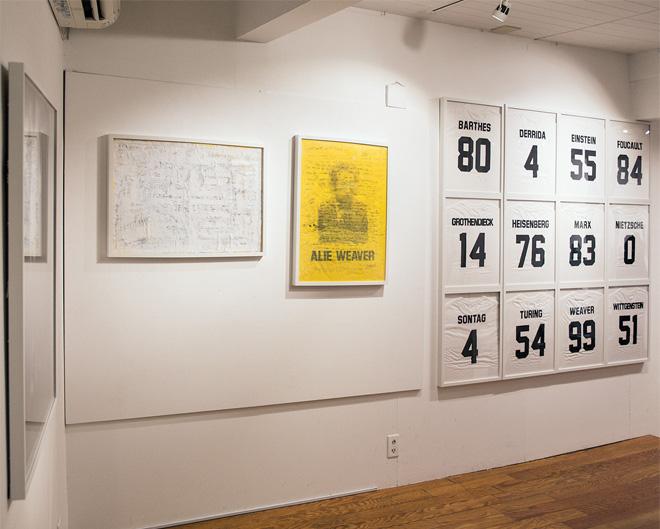
(Left)
History of the Ignorance (2018)
Mixed media
50.0 x 70.0 cm
(Center)
The Formal Structure of the Question of Being, ALIE WEAVER (2018)
Mixed media
50.0 x 70.0 cm
(Right)
Non-trivials (2018)
Silkscreen on cotton T-shirt
42.5 x 52.5 cm
Artworks by KLEINSTEIN

