Magazine
Essay Series “Walking Now” MISHIMAGAZINE #1 – Michael Wolf
The original text was written in Japanese for MISHIMAGAZINE in January 2016. This post is an English translation and republication of the original article.
To feel nostalgia is to direct oneself toward the past. Reading classics, we discover that people of old felt and lived much as we do, and we can feel nostalgia for worlds we never experienced. Looking over history, we notice that human universality connects us with people of the past across borders, races, and time. The Bible, Buddhist scriptures, and the writings of ancient philosophers continue to give hints to modern people, and commentaries on them are too numerous to count. Living in the present, we labor over the words of great dead people.
The “past” we know has survived into the present because it was left in writing. It is natural, perhaps, that words that have survived time are treated more carefully than words spoken today. I remember Nagasawa in Norwegian Wood saying he reads only novels by dead writers. People have long spoken often of the dead, while speaking comparatively little about those still alive.
If the question is merely whether something remains, contemporary people may secure their existence in history through influence on Instagram or Twitter, or through the number of hits when their names are searched on Google. Whether it remains for a thousand years is another matter, but this text too will be stored somewhere on a server. Still, that is only one aspect of the present we actually see.
What about the past? When I think this way, I always imagine the people who disappeared without ever being spoken of. Socrates and Plato are representative figures of ancient Greece, but what kinds of people lived in the daily life of their age? Surely there were anonymous but witty people in ancient cities, the sort who never received a footnote and therefore may have been spared a great deal.
Six or seven years ago, by a strange guidance, I stepped into the world of fashion and began thinking about human appearances and conditions. I came to work with people of many nationalities and races, from artists to craftspeople, people with all sorts of backgrounds. Contrary to the words of intellectuals who predicted that globalization would flatten the world, among the people I met were those who lived with wisdom born from extremely personal experiences, impossible to generalize.
In this series, while writing essays freely, I want to introduce contemporary people I have actually met and spoken with, famous or unknown, and to feel a small nostalgia for the very recent past and the present.
Michael Wolf
“I will be in Tokyo in August. Let us meet.”
A red notification appeared on my mailbox icon. It was from Michael Wolf.
He was a German photographer living in Hong Kong, with whom I had stayed in periodic contact since I sent him my impressions after seeing one of his photobooks four years earlier. I first learned of him when I saw a large two-volume book titled Hong Kong Inside Outside protruding from a bookstore shelf because it could not fit properly.
The first volume, Outside, contained photographs of enormous Hong Kong apartment blocks with so many rooms one could not grasp how many households they contained. The inorganic surfaces of the buildings spread across the page like flat geometric patterns generated by a computer. When we hear the word nature, we may imagine mountains or fields, but the artificial buildings in those photographs seemed like something born from a new nature.
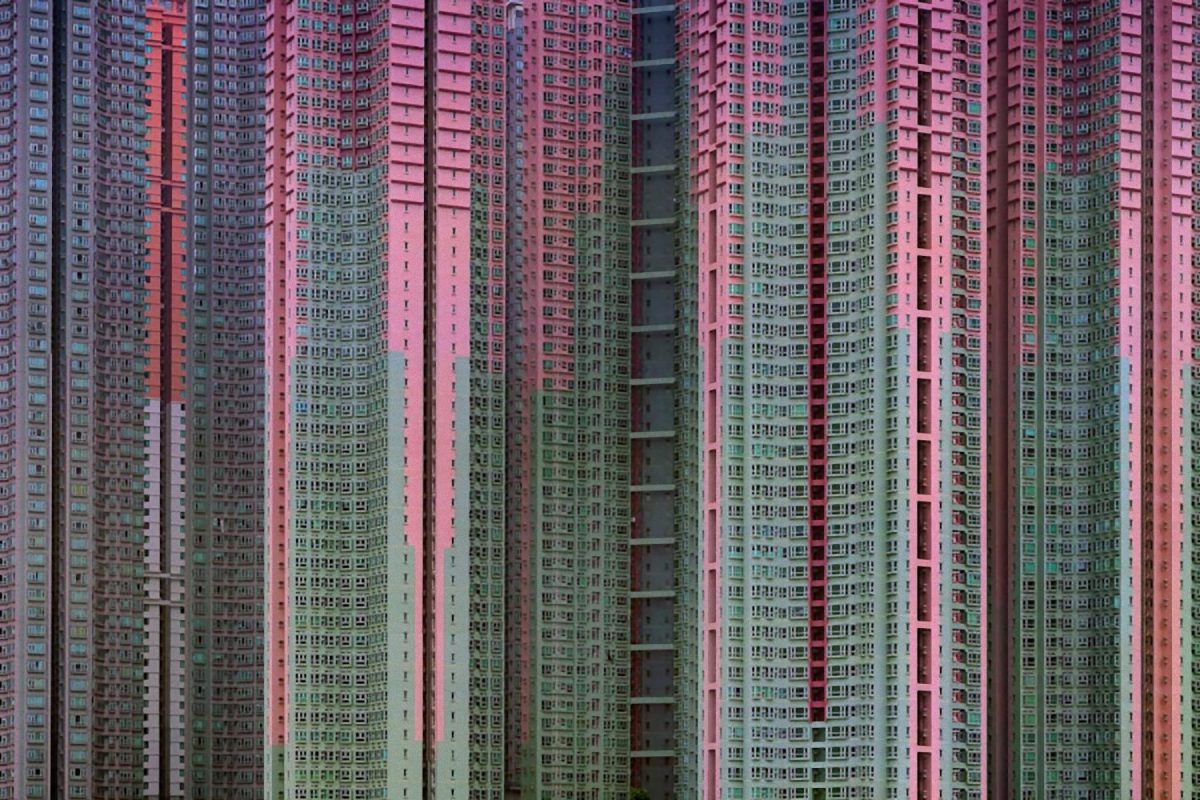
Looking at that photobook, I remembered a strange feeling I had sometimes experienced since moving to Tokyo. When I looked up from the ground at giant buildings towering over the city and saw light leaking from windows, I could not quite feel the obvious fact that countless human lives were contained beyond them. The daily acts of individual people, impossible to measure by physical dimensions, were housed in regular, inorganic boxes like imported chocolates. That vague fact always felt strange.
When I opened the second volume, Inside, the scenery beyond what I had imagined was there. The book showed residents actually living in those enormous high-rise housing blocks: people standing amid overflowing furniture and daily objects in one-room apartments of roughly thirty square meters. Beside them were questions Michael had prepared and the residents’ answers.
“What is your name?”
“How old are you?”
“How long have you lived here?”
“What is your profession? / What was your profession?”
“What do you like about living here?”
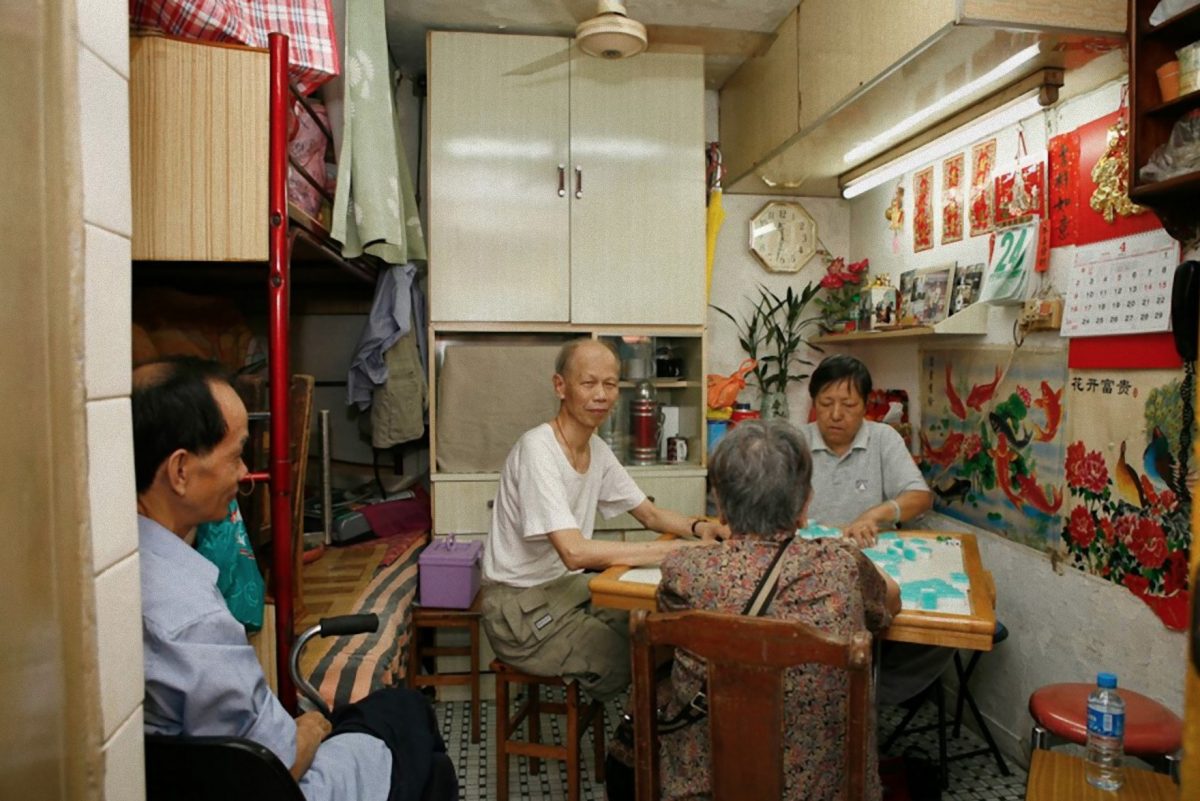
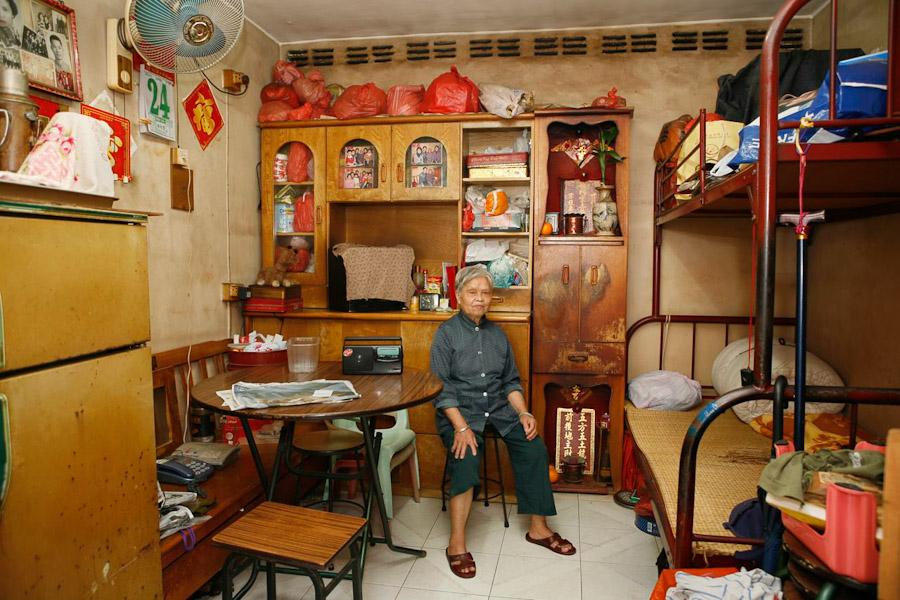
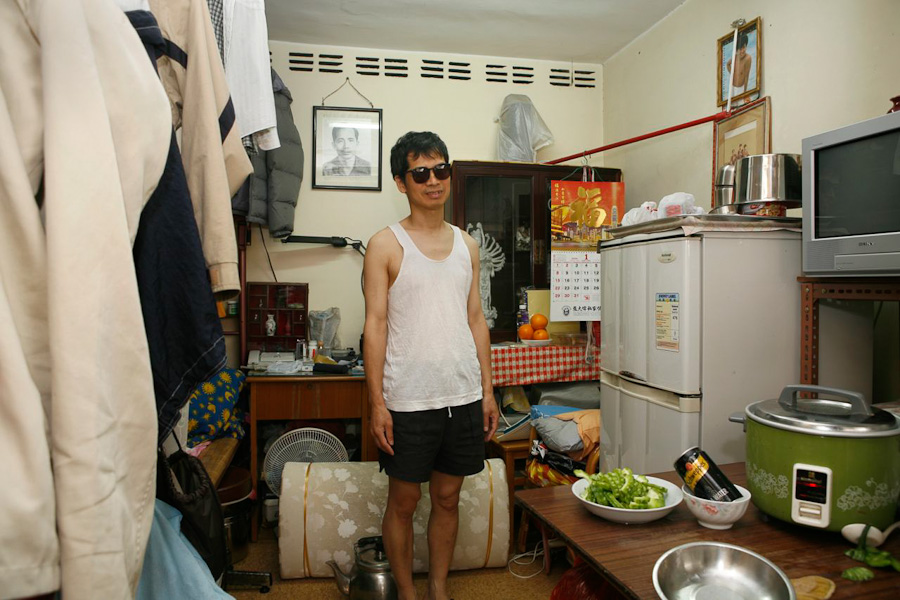
I met Michael at the plaza by the west exit of Shinjuku Station. This foreigner announced, in the middle of a midsummer afternoon, that the first thing he wanted was ramen. I took him to a recommended ramen shop nearby, and after eating chashu ramen and becoming cheerful, he and I headed to an old cafe on the east side of Shinjuku. As we walked, I asked him how he had photographed the residents of those huge apartment buildings one by one. He said that when he visited alone people were wary and would not deal with him, so he went along on the visiting days of elderly care workers and slipped in that way.
“It was interesting. There were things every home always had. When I asked why they lived there, everyone said the same real things: the rent was cheap, and their friends lived there.”
That day he had come to Shinjuku to photograph the series Tokyo Compression. He had heard that after the renovation of the Odakyu Line, the spot he liked to photograph would disappear, so he hurriedly decided to come to Japan. It was his last chance, he said, and he had to stock up on images.
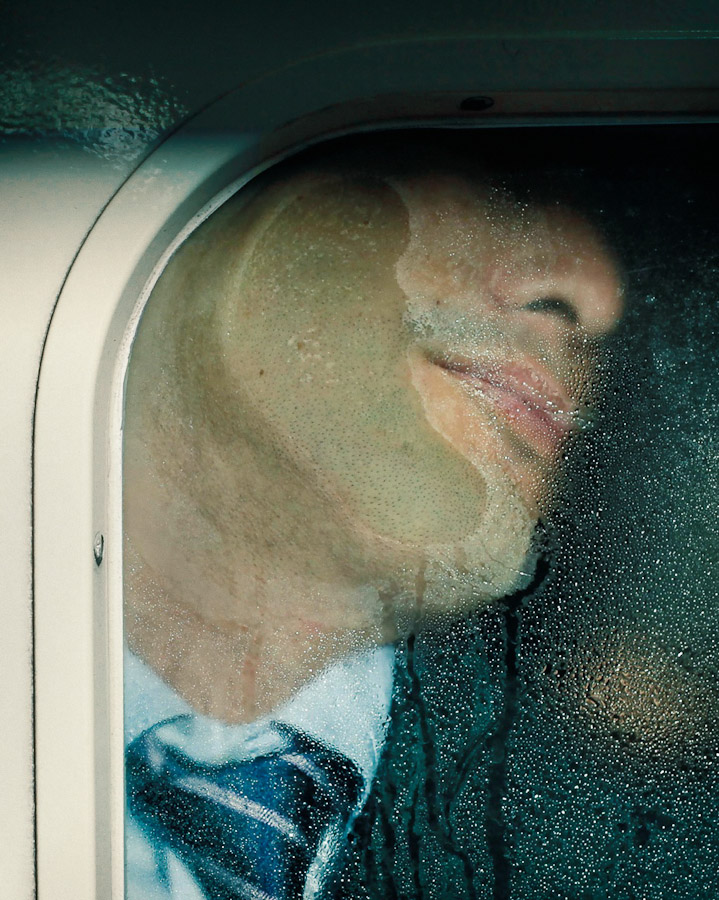

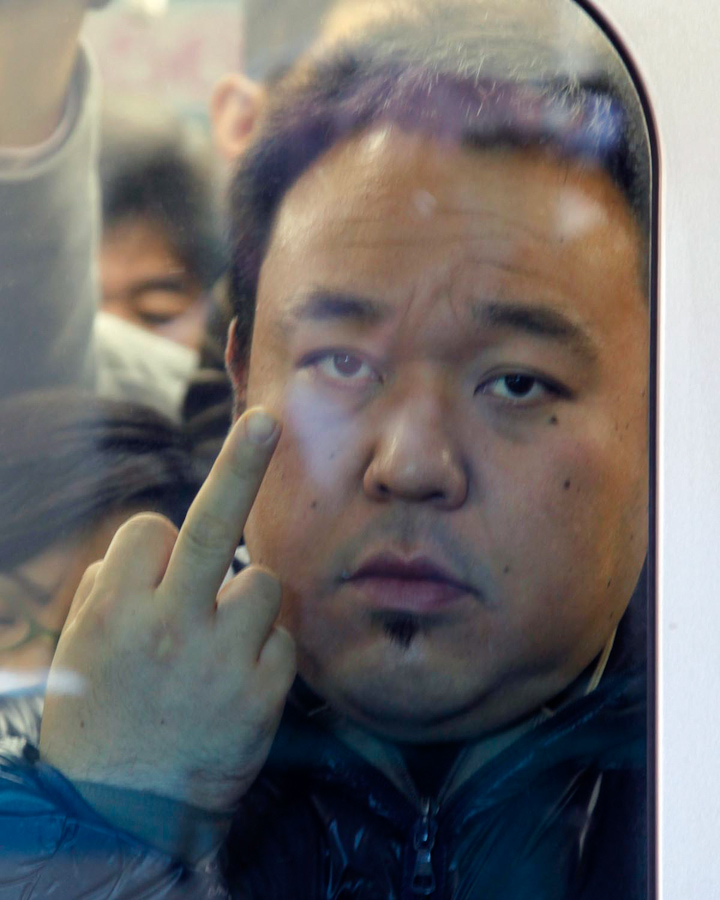
This project photographs people in Tokyo packed into crowded trains through the doors. Even people who are usually well behaved distort their faces in cramped commuter cars, trying desperately to suppress their emotions. Some show anger at being photographed.
By the time we reached the cafe and our coffee cups had emptied, we had grown comfortable, and he began to speak about many things: his transition from photojournalist to artist, his family, novels he liked, his native Germany and the America where he spent his boyhood. He had worked for many years as a photojournalist at the German magazine Stern, visited Hong Kong before the handover for work, and decided to move there in 1994. Compared with Paris, America, or Germany, Hong Kong changed every day, and he was attracted by the energy of Hong Kong people, which exceeded expectations at an angle. After moving, he gradually began photographing the casual expressions of the city as artworks.
His debut as an artist came in 2001, when he was forty-seven. That is a relatively late start, but immediately after his debut his experimental works drew attention around the world. The idea that if one cuts everyday life well enough, a nontrivial scene beyond any artificial world will appear sounds obvious when written this way. Yet when one actually looks at each photograph, one is overwhelmed by the interest, comedy, and even abnormality of the reality in which we live.
“Hong Kong is convenient. In Paris, for example, something can take thirty days to finish. In Hong Kong, the opposite happens: thirty errands can be finished in one day. I like having bases at two extremes. When I get tired of one, I go back to the other.”
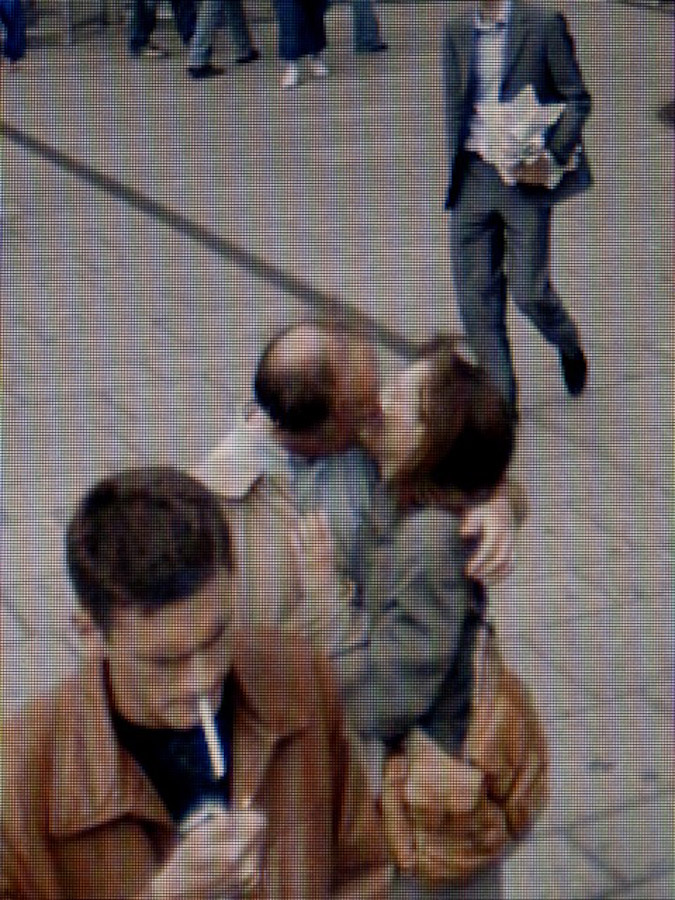
When speaking of photographs that capture a moment, Robert Doisneau’s Le Baiser de l’hôtel de ville, taken in the 1950s, is famous. Yet it is now known that the photograph of lovers kissing was staged. What is interesting about Michael’s work is that, without criticizing, without posing cynically, and without constructing the scene, he captures the comedy and tragedy of reality optimistically.
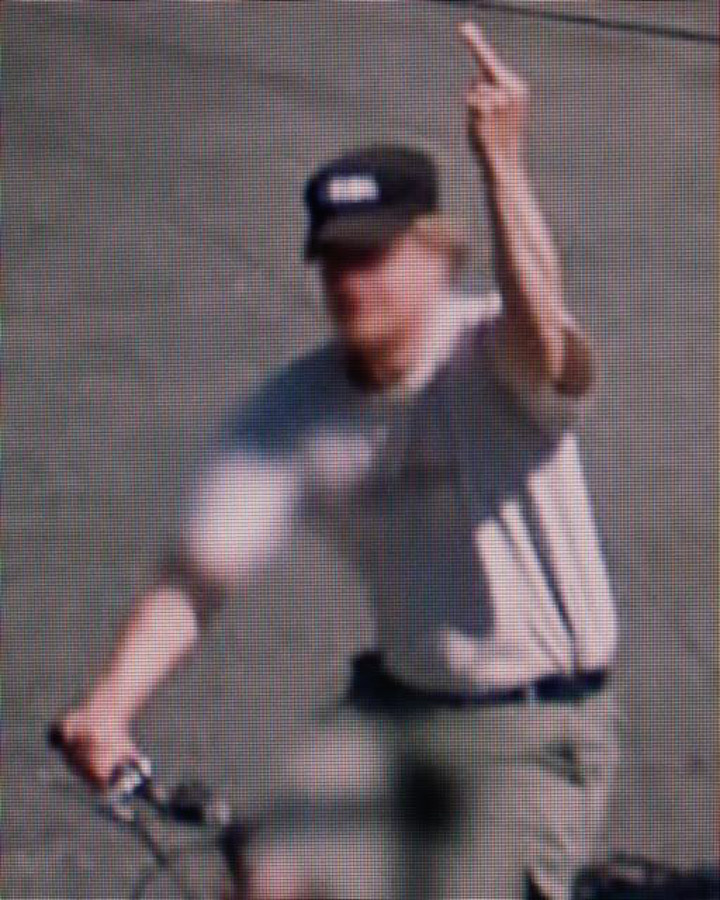
Around 2010, when the privacy of people photographed by Google Street View became a topic of discussion, he presented works made by capturing and editing Street View images from Paris and New York: FY, collecting people giving Google’s camera the finger and dogs looking at the camera while defecating; A Series of Unfortunate Events, gathering moments of people falling from bicycles, collapsing in the street, or otherwise having bad luck. In his book Paris, there are also photographs of kissing lovers, an homage to Doisneau.
Walking through back streets in midsummer Shinjuku with middle-aged Michael holding his camera like a boy with an insect net, I learned that cities have their own nature.
Michael Wolf (1954-2019)
Hong Kong Inside Outside, Peperoni Books, 2009
Tokyo Compression, Peperoni Books, 2010
A Series of Unfortunate Events, Peperoni Books, 2010
FY, Peperoni Books, 2011
Hong Kong Trilogy, 2013