Essay
STUDIOVOICE #5 — TEMA HIMA: The Art of Living in Tohoku
The original text was written in Japanese for STUDIOVOICE on June 15, 2012. This English version translates the text embedded in the archival page image.
21_21 DESIGN SIGHT: “TEMA HIMA: The Art of Living in Tohoku”
It Is Part of Someone’s Life
“In the things made in Tohoku, the idea of ‘time,’ so often pushed aside by a modern society that has pursued rationality, still lives on. These are handmade processes repeated through long, severe winters; materials gathered from mountains and seas, nourished by nature. The exhibition introduces the processes, techniques, and appeal that have made these forms of making possible, and asks how we might carry their way of thinking into tomorrow.”
Looking at the dignity of handwork now in danger of disappearing, and at the plain, everyday lives of people in Tohoku, whose lives were re-recognized after the earthquake, my heart moved almost without resistance. Perhaps this had something to do with the fact that I myself am from Tohoku. But it also felt as if something more fundamental had been touched.
At first glance, this exhibition might appear to be a straightforward cultural-documentary project about Tohoku after the disaster. In fact, it does not stop at introducing familiar crafts. In a way rarely seen in museums or galleries, it places food from Tohoku at the center of the exhibition. Every object on view is the result of human hands. They are things made, as they have always been, by spending “tema” and “hima”: labor, care, and time.
Compared with half a century ago, now that mechanized industry has developed, things seem to be produced at random and with extreme efficiency. Yet even today, the number of products born without any human hand involved is smaller than we might imagine. Manufacturing may try to mechanize its processes, but in the end there remains the dilemma that human hands cannot be completely removed. The inexpensive products of mass production are, in many cases, supported not only by automation but also by the handwork of low-wage laborers outside Japan. Until an object comes into being, human “time” is used. That time is part of someone’s life.
We often encounter environmental activists in the media who remind us that our lives are supported by nature. But we are not often made to recognize that the lives we take for granted are also supported by other people’s time, by the continuity of other lives.
The documentary works in the exhibition, which show the faces of people living in the harsh cold of the north, have a power that moves the heart.
Perhaps this is because they awaken a latent memory: not merely a sentiment for Tohoku, but the realization that, if we look back through a long history, neither we nor our ancestors lived lives so different from these.
The exhibition also places food, an act almost spiritual in its contact with life, on equal footing with craft. It has great value in how it re-presents, as part of the processes of daily life, folk-cultural forms that had too often been introduced simply as a category of shaped objects.
Folk discovery. The present after the rise of industrial design. What TEMA HIMA seems to be asking is not merely the conventional question of craft, “How do good things bring about good events, and how do they make good people?” Rather, it points to a deeper question: “What does it mean to live well?”
Seen through the time in which the past and the present are alive together, what were we in the past, what are we now, and what might we become in the future? Even in a situation where the word “future” has become attached to so many forms of anxiety and stagnation, what, in the first place, were we? Through the metaphor of Tohoku, the exhibition seems to ask a radical question.
By a strange coincidence, alongside TEMA HIMA, the Japan Folk Crafts Museum was holding Tohoku Crafts and Muneyoshi Yanagi, while the Meguro Museum of Art was presenting an exhibition on Charlotte Perriand, a master of design and an important transmitter of modern industrial design in Japan. Both exhibitions ended on June 10.
These days, I often feel the dark mood of people involved in making things: a desire, perhaps, to stop for a moment and think.
Exhibition Information
“TEMA HIMA: The Art of Living in Tohoku”
Period: through Sunday, August 26, 2012
Hours: 11:00–20:00 (entry until 19:30)
Admission: General ¥1,000; university students ¥800; junior high and high school students ¥500; elementary school students and younger free
Venue: 21_21 DESIGN SIGHT (Tokyo Midtown, Garden Area)
Address: 9-7-6 Akasaka, Minato-ku, Tokyo
Website: 21_21 DESIGN SIGHT
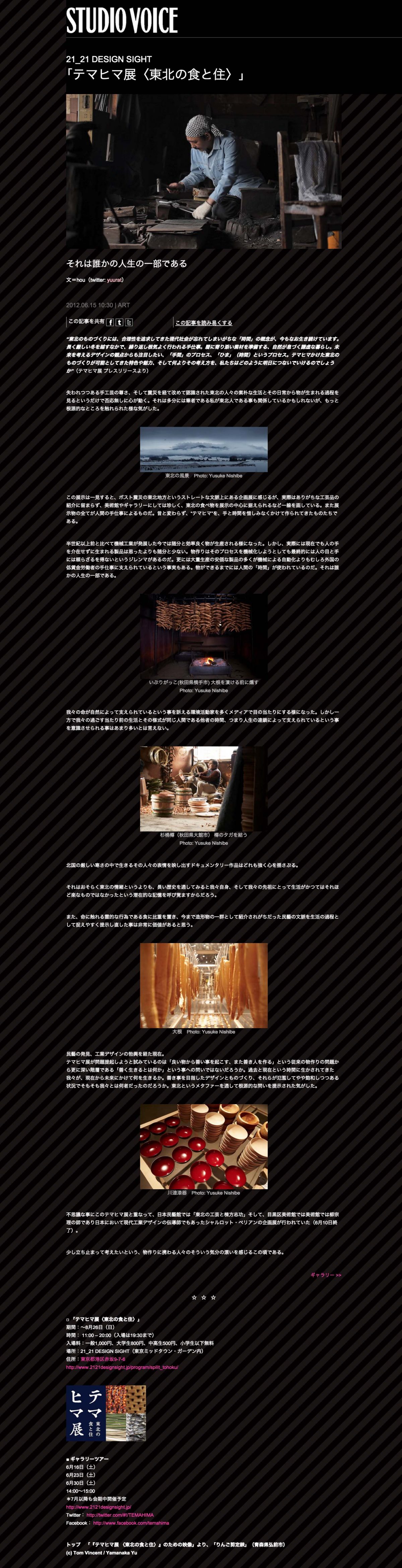
Top image: from the film produced for TEMA HIMA: The Art of Living in Tohoku, “Ringo Sentai Kurenai” (Hirosaki, Aomori). © Tom Vincent / Yamanaka Yu